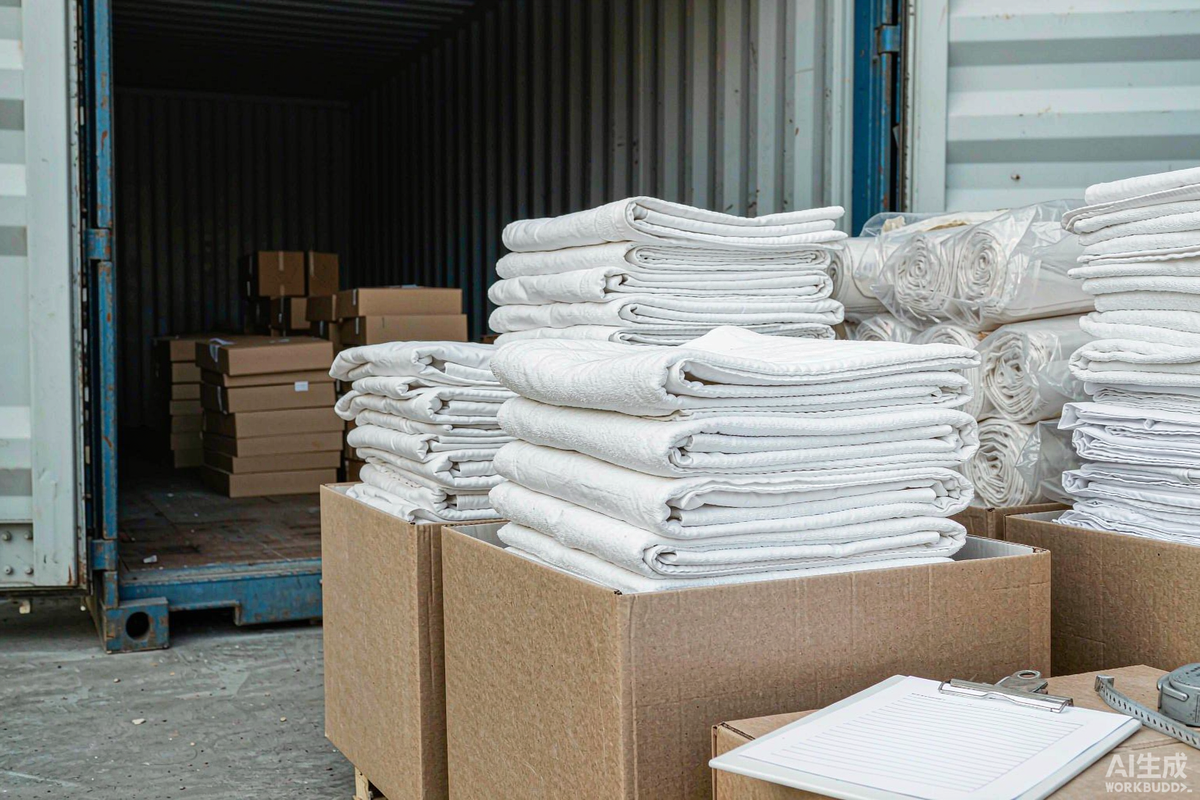
A hotel towel quotation usually arrives as a price per piece and very little else. What it does not tell you is whether the order you are about to place fills a container or leaves half of it empty. Freight is priced per container, not per towel, so a half-empty box costs almost exactly the same as a full one. That gap is where first-time importers lose the most money, and it is entirely avoidable with about ten minutes of arithmetic.
What follows is that arithmetic, using container figures that are standard across carriers and carton volumes that are typical for hotel towel and bed linen export packing. Once you have run it once, you will never look at a quotation the same way.
The three numbers that decide your load
Container capacity is quoted two ways and buyers routinely confuse them. Gross volume is the empty box. Usable volume is what you can actually load once carton stacking inefficiency is accounted for. On a 40ft standard container the difference is around ten cubic metres, which is roughly a fifth of the box. Planning against gross volume is how buyers end up leaving goods on the dock.
The second number is payload, and almost nobody shipping hotel linen gets anywhere near it. The third is the volume of a single carton of your product, which is the only figure you actually need from your supplier to complete the calculation.
Container reference figures
| Container | Internal dimensions | Gross volume | Usable volume | Net cargo capacity |
|---|---|---|---|---|
| 20ft standard | 5.90 x 2.35 x 2.39 m | 33 CBM | 26 - 28 CBM | up to 25.8 t |
| 40ft standard | 12.03 x 2.35 x 2.39 m | 67 CBM | 55 - 58 CBM | up to 26 t |
| 40ft high cube | 12.03 x 2.35 x 2.70 m | 76 CBM | 65 - 68 CBM | up to 26 t |
What a carton of hotel linen actually occupies
This is the table to ask your supplier for. Carton dimensions and pieces per carton vary by product and by packing method, so treat these as representative rather than fixed, but they are close enough to plan an order around.
| Product | Pieces per carton | Volume per carton | Gross weight per carton |
|---|---|---|---|
| Bath towel, 500 GSM | 100 | 0.040 CBM | 8 kg |
| Bath towel, 600 GSM | 100 | 0.050 CBM | 10 kg |
| Flat sheet | 200 | 0.060 CBM | 12 kg |
| Fitted sheet | 200 | 0.065 CBM | 13 kg |
| Pillowcase | 300 | 0.050 CBM | 10 kg |
| Bathrobe | 50 | 0.080 CBM | 15 kg |
How many towels fit, in practice
Divide the usable volume by the carton volume, then multiply by the pieces per carton. The result is an upper bound; real loads come in 5 to 10 percent lower once the top layer and any irregular cartons are accommodated.
| Container | 500 GSM bath towels | 600 GSM bath towels | Flat sheets |
|---|---|---|---|
| 20ft (27 CBM) | 67,500 | 54,000 | 90,000 |
| 40ft standard (57 CBM) | 142,500 | 114,000 | 190,000 |
| 40ft high cube (66 CBM) | 165,000 | 132,000 | 220,000 |
Hotel linen is volume-bound, not weight-bound
Look at the weights behind those numbers. A full 40ft high cube of bath towels comes to about 13.2 tonnes against a payload allowance of 26 tonnes. A full container of flat sheets lands at the same figure. Every scenario in the table above uses roughly half the weight the container will legally carry.
This runs opposite to how most importers instinctively plan. They worry about going over the weight limit. For hotel linen the risk is the reverse: you run out of cubic metres long before you run out of kilograms. That single fact drives three decisions - which container to book, whether to add product lines, and when the freight cost stops making sense for your order size.
Choosing the container: high cube, standard, or 20ft
Need these specs quoted for your property?
Tell us your hotel tier, quantities and timeline — get a free, no-obligation quote within 24 hours.
The high cube adds 31 centimetres of internal height, which is about 10 cubic metres of extra space, or roughly 18 percent more volume. On most lanes the freight premium for a high cube over a standard 40ft is a small fraction of the total freight bill.
For a product that is volume-bound, that extra space is close to free capacity. Ask for a 40ft HC explicitly and in writing. Forwarders book standard 40ft boxes by default, and for lightweight linen that default quietly costs you ten cubic metres on every shipment.
A 20ft is the right call for a first order you are testing, or when your destination has handling or inland transport restrictions that rule out 40ft boxes. It is also reasonable if the container is part of a mixed load with genuinely dense goods.
Below roughly 12 to 18 CBM, less-than-container-load shipping is usually cheaper than booking a 20ft. Above it, the balance tips quickly toward a full container - and once you are past 35 to 45 CBM, a 40ft is almost always the better answer. Those break-even points move with the lane and the season, but they are the right order of magnitude to plan around.
Filling the weight you are not using
Because a linen container leaves about half its payload unused, the cheapest goods in your order are the ones that fill that weight without consuming much volume. Bath mats, mattress protectors and table linen are all denser than towels, which makes them natural ballast for a container that would otherwise ship air.
This is where the structure of your supplier starts to show in the freight bill. We are a manufacturer alliance of FOB export factories: each member factory owns and operates its own production facility, holds its own export licence and can invoice FOB in its own name, accepts buyer audits and on-site visits, and works to the alliance's written specification and inspection standard. Because that discipline is a condition of membership, a single order can be assembled across towel, bedding, bathrobe and table linen lines without a trading intermediary in the middle. One contract, one spec sheet, one inspection standard, one set of shipping documents - and the member factory that makes your order is named on the contract and ships under its own licence.
Before you book: five questions and the one number that matters
Send your supplier these five questions before you confirm a booking. Every one of them changes the number.
- What are the carton dimensions and pieces per carton for each SKU in my order?
- How many cartons in total, and what is the total volume in CBM?
- What is the total gross weight of the shipment?
- Will the goods ship palletised? Palletising typically costs 10 to 15 percent of your usable volume.
- Is the booking a high cube or a standard box, and is that stated on the booking confirmation?
A supplier who can answer all five without going away to check is a supplier who has shipped these products before. One who cannot is guessing, and you will pay for the guess at the port.
The figure worth carrying into your next negotiation is not the price per towel. It is the volume your order occupies and the fraction of the container it fills. Get that number and two things follow immediately: you can compare quotations on landed cost rather than unit price, and you can see exactly how much room you have left to add product lines that cost almost nothing extra to ship. Freight is the line item buyers scrutinise least and can control most.
This article was written for hotel linen buyers sourcing from China. For custom hotel linen inquiries, visit nantonglinens.com.
Shop Related Products
Free PDF: Complete Hotel Linen Buying Guide
Step-by-step procurement guide covering specs, MOQ, pricing, QC, and shipping — based on real Dieshiqiao experience.
Need help sourcing hotel linens?
Get a free quote within 24 hours. No commitment required.
Request a QuoteRelated Articles
Pre-Shrunk vs Sanforized Hotel Sheets: What to Write in the PO
Sanforized and pre-shrunk are not the same promise. What each one actually certifies, what your laundry really does, and the lines to add to the PO.
Towel Pile Height vs Terry Weight: Why 600 GSM Feels Different
Two 600 GSM hotel towels can feel completely different. Here is how pile height drives feel, drying and wash life, and the two specs to lock in writing.
Air-Jet vs Rapier Weaving: What Changes in Hotel Sheets
Both loom types make hotel sheets, but the one your mill runs decides weft stop marks, yarn tolerance, price and cut width. Here is what to ask.