Long-Staple Cotton for Hotel Sheets: How to Verify the Claim
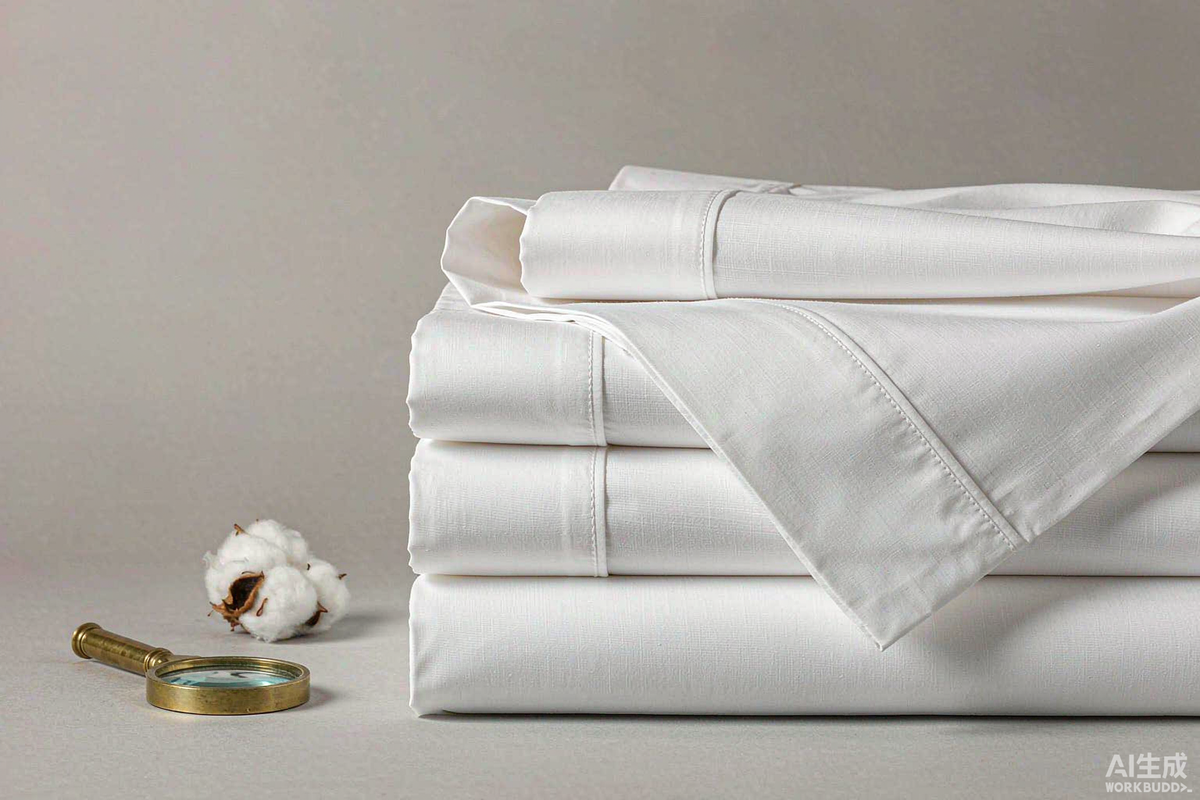
Three mills quote the same 300-thread-count sheet. All three spec sheets say 100% long-staple cotton. The quotes differ by 40%, and nothing on those sheets tells you which supplier is telling the truth. Long-staple is a standardised fibre classification with a measurable floor, and it is also eight characters anyone can type. Ask for the two numbers that make the claim checkable.
The Word Is Regulated. Your Spec Sheet Is Not.
There is a definition on both sides of the trade. China's national standard for long-staple cotton, GB/T 19635-2024, fixes 36 mm as the standard length grade. Upland cotton, the G. hirsutum species that makes up more than 90% of the world crop, typically measures 25-32 mm. The USDA classes American Pima, at 32-40 mm, as extra-long staple; in commercial use the cut-off is usually quoted at about 35 mm.
So long-staple is not an adjective. It is a floor: a fibre measuring 35 mm or more as upper half mean length (UHM) on an HVI machine.
The Second Number Buyers Forget: Micronaire
Length alone is half an answer. The missing half is micronaire, an airflow measurement of how fine and how mature the fibre is. Upland usually reads 4.0-4.9; genuine long-staple and Pima read 3.7-4.2. A Xinjiang regional standard for Awati long-staple cotton, effective 31 August 2026, allows 3.5-4.4 and sets its top length grades at 37-40 mm.
This matters because a bale can be long and still be coarse. A 36 mm fibre reading 4.8 micronaire spins hairy and pills; the same 36 mm at 3.9 is the fibre the premium is paid for. When a supplier quotes length and goes quiet on micronaire, that silence is your number.
| Parameter | Upland (G. hirsutum) | Genuine long-staple / ELS | What to put on the PO |
|---|---|---|---|
| Species and world share | 90%+ of the global crop | G. barbadense, about 3% of the crop | Species name, not a marketing word |
| Staple length (UHM) | 25-28 mm on HVI bales; USDA class 22-33 mm | 36.5-38 mm (Pima); Awati grades 37-40 mm | A floor in millimetres: 36 mm minimum |
| Micronaire | 4.0-4.9 | 3.7-4.2 (Awati standard allows 3.5-4.4) | A range, e.g. 3.7-4.2 |
| Breaking tenacity | 28-32 g/tex | 36-42 g/tex; Awati standard 40 cN/tex minimum | A floor, not an average |
| Length uniformity index | 80-83% | 85-87%; Awati standard 86% minimum | 85% minimum |
| Practical spinning limit | Ne 40-60 | Ne 120-200+ | Count plus ply, e.g. 60s single |
Four Ways the Word Gets Stretched on a Spec Sheet
None of these four are rare, and three are not even dishonest.
- Upland at the top of its class. A 31-32 mm upland bale is a good bale and sits at the long end of the upland range, but the trade threshold for long-staple is 35 mm. Ask for the millimetre figure.
- Blend dilution. A fabric that is 30% long-staple and 70% upland can still carry long-staple cotton in the headline. Put a percentage floor on the purchase order.
- Count substituted for grade. A 60s combed yarn spun from upland is a legitimate product, and it is often sold as long-staple because buyers confuse a fine yarn with a fine fibre. Count and staple are independent axes.
- The ply trick. 120s on a label is often 60s two-ply, which is a different product from a 120s single yarn. If the sheet does not say single or 2-ply, the number cannot be read.
What Long-Staple Buys, and What It Does Not
Long-staple buys three things: fewer protruding fibre ends per metre of yarn, which is what pilling resistance actually is; higher bundle strength, which shows up as fewer tears at the fold and the hem, where hotel sheets fail first; and the fineness that makes 80s and finer yarns spinnable at all, which is the raw material of a luxury hand-feel.
It buys nothing on two axes buyers assume it covers. Shrinkage is a finishing property: sanforizing, compacting and pre-shrinking are what stop a sheet coming back short, and a perfect 36 mm bale with no shrinkage control will still shrink. Bleach tolerance is a dyeing question.
Decision rule: long-staple earns its premium in exactly two situations, where the hand-feel is guest-facing at 80s and finer, and where the laundry is heavy enough that sheets fail by pilling rather than tearing. For a mid-market property buying 60s percale, the money is better spent on density and finishing than on fibre grade.
The premium is measurable. In early September 2026 the Xinjiang cotton price index quoted grade-137 long-staple cotton at RMB 26,820 per tonne against RMB 17,933 per tonne for 3128B upland, a fibre premium of roughly 50% before spinning and finishing. If a long-staple quote matches an upland quote, check the fibre content first.
Need these specs quoted for your property?
Tell us your hotel tier, quantities and timeline — get a free, no-obligation quote within 24 hours.
Density Is the Second Half of the Check
A fine yarn can be woven thin. Ashenhurst's rule gives the maximum sett a yarn can hold, roughly 28 times the square root of the yarn count in threads per inch, and plain weaves normally run at 60-70% of that maximum. In practice a 60s percale lands around 290-310 total thread count and an 80s around 380-450. So a sheet described as 80s long-staple at 200 thread count is internally inconsistent.
This test is more useful than most laboratory tests because it can be run on the quotation, before you pay for a sample.
| Yarn count | Typical total thread count | Where it is normally sold | The giveaway |
|---|---|---|---|
| 40s | 200-210 | Economy and budget properties | Anything under 200 TC pills within a few washes |
| 60s combed | 290-310 | 3-4 star and mid-market chains | A high count claimed at low density |
| 80s | 380-450 | 5-star and resort | 80s quoted at 200-250 TC |
| 100s and finer | 500+ | Flagship and luxury | A very high count at a low price is usually multi-ply |
Six Fields That End the Argument
Put six fields on the spec sheet and require them before any quote is treated as comparable.
- Fibre species and origin: G. barbadense, Xinjiang, or American Pima.
- Staple length as a floor in millimetres: 36 mm minimum.
- Micronaire as a range, for example 3.7-4.2.
- Length uniformity index as a floor: 85% and above.
- Breaking tenacity as a floor: 36 g/tex and above.
- Yarn as count plus ply: 60s single, or 60s/2.
Add two finishing fields so the other axis is covered: post-wash gsm and post-wash shrinkage, measured to a named test method. Then ask for the bale's HVI report. HVI is the instrument these numbers come off, so a mill that grades its bales can produce the sheet on request, and a mill that does not, cannot.
Where a Long-Staple Order Actually Comes From
Long-staple is a thinner market than upland. Upland grades are stocked continuously and can be bought off the shelf in most weeks of the year. Genuine 36 mm-plus Xinjiang long-staple is bought against specific grades and bales, and new-crop cotton is ginned from the autumn harvest onward, so a bale's HVI report does not exist until after ginning. An order placed earlier is bought on class and origin, not measured fibre data.
In the Dieshiqiao and Chuanjiang cluster around Nantong the practical picture is this. Bed sheets run at a minimum of 100 pieces per size and specification combination, with bulk production at 25-35 days and samples in 5-7 days, extending to 7-10 days where a shade is dyed or a logo embroidered; August to November peak season adds 7-10 days. Towels run on different member lines at 20-30 days. Fabric by the metre runs 30-45 days.
Nantong Linens is a manufacturer alliance of FOB export factories, and long-staple bedding comes off the founding member's bedding mill in Chuanjiang Town, Tongzhou, a 5,000 m² plant. Membership is not open to traders: every member owns and operates its own production facility, holds its own export licence and can invoice FOB in its own name, accepts buyer audits and on-site visits, and works to the alliance's written specification and inspection standard. That last term is why the six fields are enforceable rather than decorative. See how the alliance is structured and which member factory covers which category.
Action for your next RFQ: send your spec sheet back to every supplier who quoted long-staple cotton and ask for the six fields plus the bale HVI report, required before deposit rather than before shipment. Two or three quotes will come back with real numbers. The rest will come back with the same eight characters in a different font, under one contract, one spec sheet, one inspection standard and one set of shipping documents.
This article was written for hotel linen buyers sourcing from China. For custom hotel linen inquiries, visit nantonglinens.com.
Shop Related Products
Free PDF: Complete Hotel Linen Buying Guide
Step-by-step procurement guide covering specs, MOQ, pricing, QC, and shipping — based on real Dieshiqiao experience.
Need help sourcing hotel linens?
Get a free quote within 24 hours. No commitment required.
Request a QuoteRelated Articles
Pre-Shrunk vs Sanforized Hotel Sheets: What to Write in the PO
Sanforized and pre-shrunk are not the same promise. What each one actually certifies, what your laundry really does, and the lines to add to the PO.
Towel Pile Height vs Terry Weight: Why 600 GSM Feels Different
Two 600 GSM hotel towels can feel completely different. Here is how pile height drives feel, drying and wash life, and the two specs to lock in writing.
Air-Jet vs Rapier Weaving: What Changes in Hotel Sheets
Both loom types make hotel sheets, but the one your mill runs decides weft stop marks, yarn tolerance, price and cut width. Here is what to ask.