Pre-Shrunk vs Sanforized Hotel Sheets: What to Write in the PO
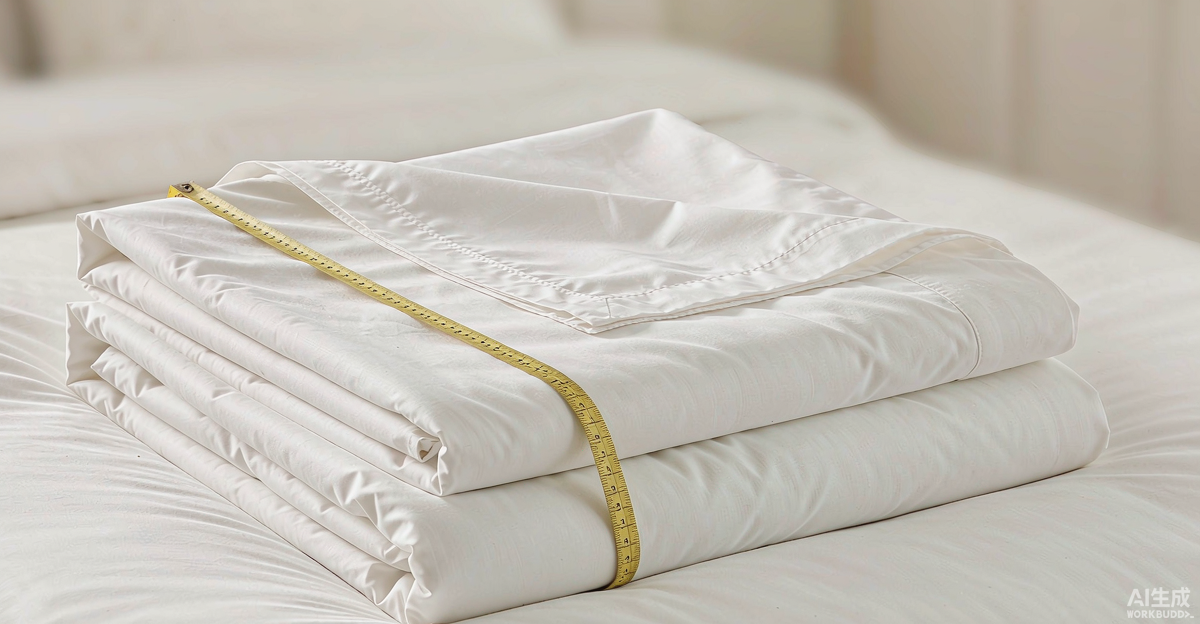
Flat sheets ordered at 300 x 300 cm, described as pre-shrunk on the spec sheet, cleared a single wash test before shipment, and eight weeks into operation housekeeping is fighting sheets whose corner pockets no longer reach the mattress. The fabric did not fail. The order did. Pre-shrunk is a description of a process, not a number you agreed to, and if the purchase order never states a tolerance, the size you receive is the size the mill's own product standard allows it to deliver. That standard is looser than most buyers assume.
Pre-Shrunk Is a Description. Sanforized Is a Licence
Sanforizing was patented by Sanford Cluett in 1930. Damp woven fabric is carried over a compressible rubber blanket, compressed in the warp direction, and set with steam, so the yarns are forced into the position they would have shifted to on the first wash. Unsanforized cotton can lose 5-8% of its length on that first wash; the process takes it to under 1%.
The word Sanforized is a registered trademark, not a generic adjective. Fabric carrying the mark has been independently tested to residual shrinkage of no more than 1% in either direction, and the higher Sanforized-Plus rating to no more than 0.5%. Pre-shrunk carries no licensed ceiling and no mandatory test. The working bands quoted in textile-testing references are roughly 1-2% for pre-shrunk, under 1% for Sanforized, and anything above 5% in either direction excessive - but only the Sanforized band is backed by a mark someone can lose.
One further detail matters more than buyers expect. The rubber-blanket process compresses length only. Width is controlled separately by tentering, where the fabric is held to a defined width through drying and heat setting. A mill that sanforizes without tentering has stabilised half the sheet.
What the Standard Behind Your Order Actually Allows
If your purchase order does not name a shrinkage tolerance, the mill has not done anything wrong by defaulting to a Chinese product standard. You should simply see the numbers before you accept that default.
| Standard | Covers | Warp / weft allowance |
|---|---|---|
| GB/T 28459-2012, public-use textiles | Institutional and hotel textiles | warp -10.0%, weft -2.0% |
| GB/T 22800-2009, star-rated tourist hotel textiles | Hotel bed, bath and F&B linen | approx. +3.0% to -5.0% |
| GB/T 19817, decorative textiles | Decorative woven fabrics | +2.0% to -4.0% |
| Draft revision, public-use textiles | Bedding washed in an industrial laundry, 3 cycles | target +2.0% to -6.0% |
| Sanforized licence mark | Certified fabric, any end use | max 1.0% each direction (Sanforized-Plus 0.5%) |
The revision now in draft for public-use textiles runs the other way: it tightens the old -10% warp figure to a target of +2.0% to -6.0%, tested in a simulated industrial laundry at 60-70 C with flatwork ironer drying, and it accepts that dimensional change only stabilises after three complete wash-dry cycles. Two things follow. First, the most generous figure a Chinese mill can legitimately point to for hotel bedding is around -6% warp. Second, a one-cycle test result is not a number you can hold anyone to.
Testing itself runs on GB/T 8628 for specimen preparation, marking and measurement, with 350 mm or 500 mm benchmarks read to 1 mm; GB/T 8629-2017 for the wash and dry programmes; and GB/T 8630-2013 for calculating the result. ISO 5077 and ISO 6330 are the European equivalents, AATCC 135 the North American one. Name the method in the order or the number means nothing.
Which Categories This Even Applies To
Mechanical pre-shrinking applies to woven fabric. It is not a universal answer, and asking for it on the wrong category tells a mill that the specification was copied from somewhere else.
| Category | Can it be sanforized? | What actually sets the dimension | What to put in the order |
|---|---|---|---|
| Cotton flat and fitted sheets, duvet covers | Yes, woven | Warp compression plus tentering | Finished size after 3 wash-dry cycles, max 3.0% warp and weft |
| Pillowcases | Yes, same fabric | Fabric stability plus seam allowance | Same tolerance, plus a seam pucker check after washing |
| Terry towels and bath mats | No, terry is a loop structure | Yarn twist, loop relaxation, tumble drying | Length and width change after 3 cycles, no sanforizing claim |
| Bathrobes | Woven velour yes, terry no | Fabric plus body and seam shrink | Test the finished garment, not the fabric roll |
| Spun polyester banquet linen | No, heat-setting instead | Stenter heat-setting | Confirm heat-set on a stenter, not sanforized |
| Cotton damask banquet linen | Yes, usually with resin | Sanforizing plus durable-press resin | Ask for the formaldehyde and OEKO-TEX position on the resin |
Two rows in that table carry real money. Spun polyester banquet linen is heat-set on a stenter, so a supplier offering sanforized table linen is describing the wrong process. And cotton damask with a durable-press resin finish is where formaldehyde limits and OEKO-TEX requirements enter the conversation, because the resin chemistry is what carries them.
Where the Shrinkage Hides: Cut Size vs Finished Size
Ask for a 300 cm flat sheet and you will get a 300 cm flat sheet. The interesting question is what was on the cutting table.
Need these specs quoted for your property?
Tell us your hotel tier, quantities and timeline — get a free, no-obligation quote within 24 hours.
To land 300 cm after roughly 5% warp relaxation, the mill cuts about 315 cm. On 10,000 flat sheets that 15 cm allowance is around 4,500 m2 of woven cotton - the equivalent of some 500 extra sheets - that never reaches a guest. That is not waste; it is a legitimate engineering allowance. The problem is that it is invisible, and it is set by whoever writes the cutting ticket.
The second mechanism is weight, and the cluster calls it compensatory weighting. A fabric specified at 130 g/m2 finished can be woven lighter and brought up to weight by the shrinkage itself, because shrinking the area raises the mass per square metre. Nothing has to be misstated and every figure on the test report passes. What changes is how much yarn is doing the work, which surfaces later as hand feel and wash life rather than as a dimensional failure.
Neither practice is universal, and neither is dishonest on its own. But it is why a purchase order that names only a finished GSM can be satisfied by two quite different fabrics. Name the finished dimension and the cut dimension on the same line and the ambiguity closes.
Match the Tolerance to Your Laundry, Not Your Star Rating
| Laundry profile | Peak wash temperature | What cotton does | What to specify |
|---|---|---|---|
| Cold or ozone wash | 40 C or below | about 1% | Standard sanforized woven spec, plus a seam check |
| Tunnel washer and flatwork ironer | 60 C | about 1.8% | Max 3.0% warp and weft after 3 cycles |
| Tunnel washer, alkaline chemistry | 75-85 C | about 4.5% | Sanforized and tentered cotton tested at 75 C, or poly-cotton |
| Overloaded washers, dryer exhaust above 160 C | n/a | adds to every figure above | Fix drying capacity before re-specifying the fabric |
What shrinks a sheet is your laundry, not your brand tier. Domestic washing runs at 40-60 C. A commercial hotel laundry runs 70-85 C with high-alkalinity chemistry and industrial tumble drying; alkaline wash liquor swells cellulose, and mechanical action before drying compacts the yarn structure. Reported comparative trials at a Scandinavian hospital laundry put cotton sheets at about 1.8% shrinkage at 60 C and 4.5% at 85 C, with polyester-rich blends staying under 1.5% at both temperatures. A separate mill trial recorded 6.8% shrinkage on untreated 100% cotton workwear after 50 washes at 80 C, against 2.1% for a durable-press finished version of the same fabric.
Two operational rules come out of that. If a property runs 80 C tunnel washers, buying 100% cotton to a 1% tolerance is the wrong purchase: either buy cotton that has been sanforized and tentered and tested at 75 C, or move to a poly-cotton blend and stop fighting the chemistry. And check the laundry before blaming the fabric - overloaded washers and dryer exhaust above 160 C each add measurably to shrinkage, and neither is a textile defect.
Fitted sheets are where the number becomes an operational failure. A 35 cm corner pocket that loses 4% of its depth is 33.6 cm, and on a thick mattress with a topper that sheet is off the bed before the guest notices the thread count.
What to Write in the Order, and What Sanforizing Should Cost
- State the process, not the adjective: fabric to be sanforized (woven) or compacted (knit) before cutting.
- State the result: maximum dimensional change 3.0% warp and 3.0% weft after three complete wash-dry cycles, per ISO 6330 or GB/T 8629, measured per GB/T 8628 or ISO 5077, on fabric from the production dye lot.
- State the basis: all sizes in this order are finished dimensions after pre-shrinking, with cut dimensions declared separately by the supplier.
Cost is not the obstacle. Published trade figures put sanforizing at roughly USD 0.03-0.10 per yard, or about USD 0.10-0.15 per metre as a cost impact, with steam relaxation at USD 0.02-0.05 per yard, garment washing at USD 0.10-0.40 per piece, and a third-party wash-shrinkage test at USD 5-50. If a supplier quotes a meaningful premium for the word sanforized, you are not paying for the process.
And if a supplier will not run a three-cycle test on the production lot, that refusal is the answer you needed. Order the test instead of arguing about the claim; it costs less than one rejected carton.
The bedding on your order is made at the founding member's 5,000 m2 mill in Chuanjiang; towels, bathrobes and table linen come from member factories that specialise in them. Every factory in the alliance owns and operates its own production facility, holds its own export licence and can invoice FOB in its own name, accepts buyer audits and on-site visits, and works to the alliance's written specification and inspection standard. One contract, one spec sheet, one inspection standard, one set of shipping documents - and the member factory that makes your order is named on the contract and ships under its own licence.
This article was written for hotel linen buyers sourcing from China. For custom hotel linen inquiries, visit nantonglinens.com.
Shop Related Products
Free PDF: Complete Hotel Linen Buying Guide
Step-by-step procurement guide covering specs, MOQ, pricing, QC, and shipping — based on real Dieshiqiao experience.
Need help sourcing hotel linens?
Get a free quote within 24 hours. No commitment required.
Request a QuoteRelated Articles
Towel Pile Height vs Terry Weight: Why 600 GSM Feels Different
Two 600 GSM hotel towels can feel completely different. Here is how pile height drives feel, drying and wash life, and the two specs to lock in writing.
Air-Jet vs Rapier Weaving: What Changes in Hotel Sheets
Both loom types make hotel sheets, but the one your mill runs decides weft stop marks, yarn tolerance, price and cut width. Here is what to ask.
Long-Staple Cotton for Hotel Sheets: How to Verify the Claim
Staple length alone proves nothing. The two numbers that define long-staple cotton, the Chinese and US thresholds, and four ways the word gets stretched.