Towel Pile Height vs Terry Weight: Why 600 GSM Feels Different
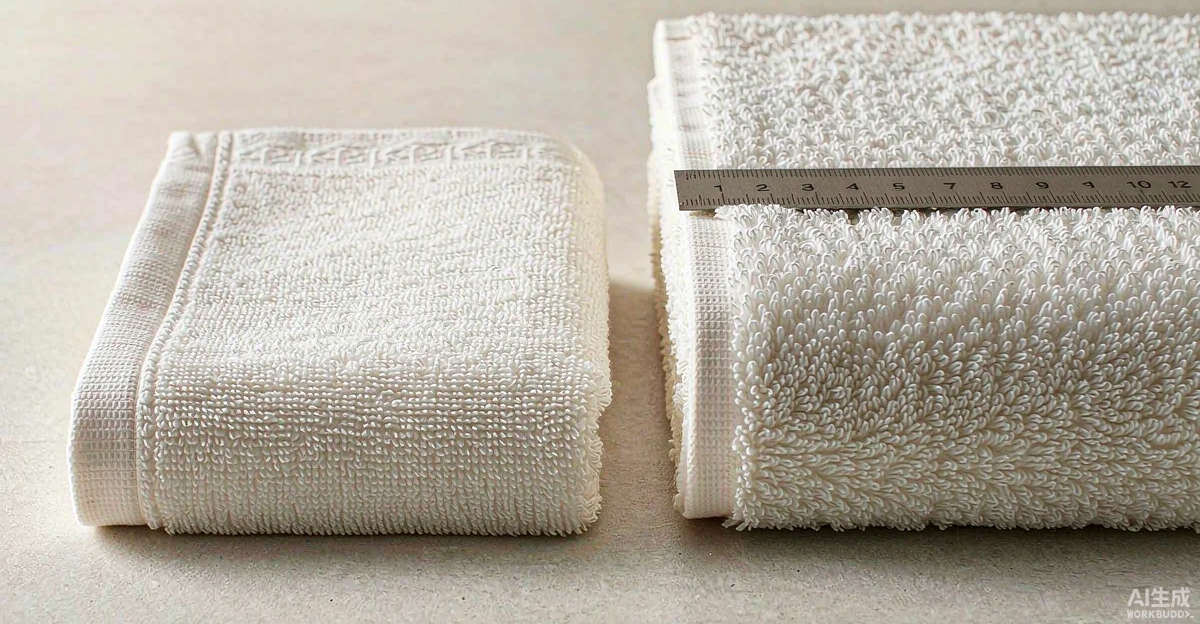
Two suppliers quote you a 600 GSM bath towel. One arrives plush and heavy in the hand; the other feels thin and flat. Both test at 600 GSM, and neither mill is lying. This is the most common surprise in towel procurement, and it comes down to the difference between weight and pile height. GSM tells you how much cotton sits in a square metre; pile height tells you how that cotton is arranged. Specify only the first and you have handed the feel, the drying speed and the laundry life of your towels to the mill's discretion.
GSM Measures Weight. Pile Height Measures Feel.
GSM means grams per square metre. It is a mass measurement, nothing more. A 70 x 140 cm bath towel covers 0.98 m2, so a true 600 GSM towel weighs about 588 g - that part is arithmetic and easy to check on a scale at inspection. What GSM does not fix is how the fibre is distributed. A terry towel is a ground cloth with loops standing up from it, and pile height - measured in millimetres from the ground cloth to the top of the loop - is adjusted independently of total weight.
Textile research on terry construction confirms these are two separate levers. In a controlled study of towel design, raising pile height by 1 mm added roughly 30 g/m2 to the fabric weight, while raising weft density by a single pick per centimetre added roughly 20 g/m2. The practical consequence: a mill can reach 600 GSM with tall, open pile or with short, dense pile, and the two towels will not behave alike. Weight is one number; the construction behind it is another.
| Pile height | Common use | What it does to the towel |
|---|---|---|
| 3-5 mm (short) | Budget and 3-star hotels, healthcare | Firmer hand, fast drying, most durable under high-temperature washing |
| 5-8 mm (medium) | Most hotel and retail bath towels | The balance point: absorbent, resilient, dries in one commercial cycle |
| 8-12 mm (long) | Luxury and spa | Plush and heavy in the hand, but matts and flattens sooner under repeated laundering |
Why Two 600 GSM Towels Feel Different
Put two 600 GSM towels side by side. One has a dense ground cloth and short loops; it feels flat and firm. The other has a lighter ground and taller loops; it feels thick and spongy. Both reach the same weight because each mill balanced ground density, pile height and pile density differently. The yarn underneath compounds the gap. A 600 GSM towel spun from open-end yarn feels dense but rough; the same weight in ring-spun combed cotton feels dense and soft. Identical weight, different hand.
Pile density is the third variable and the least visible. Two towels with the same pile height can differ in how closely the loops are packed: a dense pile feels firmer and resists matting longer, while a sparse pile of the same height feels airy when new and flattens faster. Because none of these three values is printed on the towel, the only reliable comparison is a weighed, measured sample held against the written spec - not the supplier's photograph.
| Property | 600 GSM, short dense pile | 600 GSM, tall open pile |
|---|---|---|
| Hand when new | Firm, flat, functional | Thick, plush, luxurious to the touch |
| Absorbency | Fast; wicks water quickly | High capacity, but slower to take up water |
| Drying | Dries in a normal commercial cycle | Holds more water, needs longer in the dryer |
| After repeated washing | Holds shape with only mild change | Loops matt down and stiffen within the first dozen high-temperature washes |
| Operating life | Longest under 90C institutional laundering | Shorter; replaced more often in heavy-wash programmes |
The Pile Height That Survives a Commercial Laundry
Hotel towels are not judged in a sample room; they are judged after 200 wash cycles. Here the trade's long-standing guidance is consistent: the middle band holds up best, around 5 mm. Loops longer than about 8 mm look impressive when new but flatten and stiffen within the first dozen high-temperature washes, and long pile also sheds more lint. Loops below about 3.5 mm are hard-wearing but absorb slowly and feel coarse against the skin. The judgement buyers should make is operational, not aesthetic: a short-pile towel that dries in one cycle and survives 250 washes is a better choice for a 300-room property than a tall-loop towel that must be replaced twice as often - even though the second one feels better in the showroom.
Need these specs quoted for your property?
Tell us your hotel tier, quantities and timeline — get a free, no-obligation quote within 24 hours.
What This Costs You at the Quote Stage
Pile density, not the GSM number, is where the real cost hides. Public export quotes for a 600 GSM bath towel run roughly USD 2.80-3.50 per piece at 500 pieces, and 650-700 GSM bath sheets quote at roughly USD 3.80-5.00. A mill sitting at the bottom of that band for the same stated GSM is usually buying the difference back in a lighter ground cloth or an open pile - and that is precisely what surfaces as faster matting a year into service. The way to keep a price honest is not to argue the number down; it is to specify the construction, not just the weight.
Lock Both Specs on One Sheet
The fix is procedural. A towel ordered on GSM alone cannot be rejected at inspection, because nothing in the order says what the towel should feel like. Add pile height in millimetres and a short set of construction fields, and both specs become checkable against a physical sample.
Verification is straightforward once the fields are written down. Weigh the finished towel on an accurate scale and compare it against size times GSM: a 70 x 140 cm towel at 600 GSM should land near 588 g, and a piece arriving at 520 g has already told you the ground cloth or the pile is lighter than quoted. Then lay the towel flat and measure loop height with a steel rule at several points across the centre, avoiding the edges where pile compresses. Two measurements - one weight, one in millimetres - catch the substitution that a GSM-only order cannot.
| Field | Write this | Why it matters |
|---|---|---|
| Weight | 600 GSM +/-5%, tested to ISO 3801 or ASTM D3776 | Without a tolerance and a named test method the number is not verifiable at inspection |
| Pile height | 5 mm +/-0.5 mm, measured ground cloth to loop top | Fixes the feel and drying behaviour that GSM alone leaves open |
| Pile yarn | Ring-spun combed cotton, named separately from the ground yarn | A 100% cotton line often describes the ground cloth only |
| Loop finish | Uncut terry, sheared or brushed | Brushing and shearing change the hand and are not interchangeable |
| AQL | AQL 2.5 on GSM and pile height at pre-shipment | Makes both specs checkable before the cartons leave the mill |
What to Ask Before You Book the Order
Two operational questions settle most towel orders before they start. First, minimums: alliance factories run towels from 200 pcs per colour, with a trial order from 50 pcs. A five-colour programme is five minimum runs, which is why a multicoloured order takes longer than a one-colour order of the same total volume. Second, timing: towel bulk production runs 20-30 days, with samples in 5-7 days, and peak season from August to November adds 7-10 days to both. If your opening date is fixed, work backwards from the container booking, not from the sample approval.
Put the Pile Height in the Order
Ask every mill to quote pile height in millimetres next to GSM, and to send both on the same sample card so you can measure rather than guess. That single field separates the two 600 GSM towels before the deposit, not after the first wash.
Our member factories include dedicated towel mills alongside the founding member's bedding mill, and the towel factory that makes your order is named on your contract and ships under its own export licence. Every factory in the alliance owns and operates its own production facility, holds its own export licence and can invoice FOB in its own name, accepts buyer audits and on-site visits, and works to the alliance's written specification and inspection standard. You get one contract, one spec sheet, one inspection standard and one set of shipping documents - whether you order towels alone or load them with bedding in a single container.
This article was written for hotel linen buyers sourcing from China. For custom hotel linen inquiries, visit nantonglinens.com.
Shop Related Products
Free PDF: Complete Hotel Linen Buying Guide
Step-by-step procurement guide covering specs, MOQ, pricing, QC, and shipping — based on real Dieshiqiao experience.
Need help sourcing hotel linens?
Get a free quote within 24 hours. No commitment required.
Request a QuoteRelated Articles
Pre-Shrunk vs Sanforized Hotel Sheets: What to Write in the PO
Sanforized and pre-shrunk are not the same promise. What each one actually certifies, what your laundry really does, and the lines to add to the PO.
Air-Jet vs Rapier Weaving: What Changes in Hotel Sheets
Both loom types make hotel sheets, but the one your mill runs decides weft stop marks, yarn tolerance, price and cut width. Here is what to ask.
Long-Staple Cotton for Hotel Sheets: How to Verify the Claim
Staple length alone proves nothing. The two numbers that define long-staple cotton, the Chinese and US thresholds, and four ways the word gets stretched.