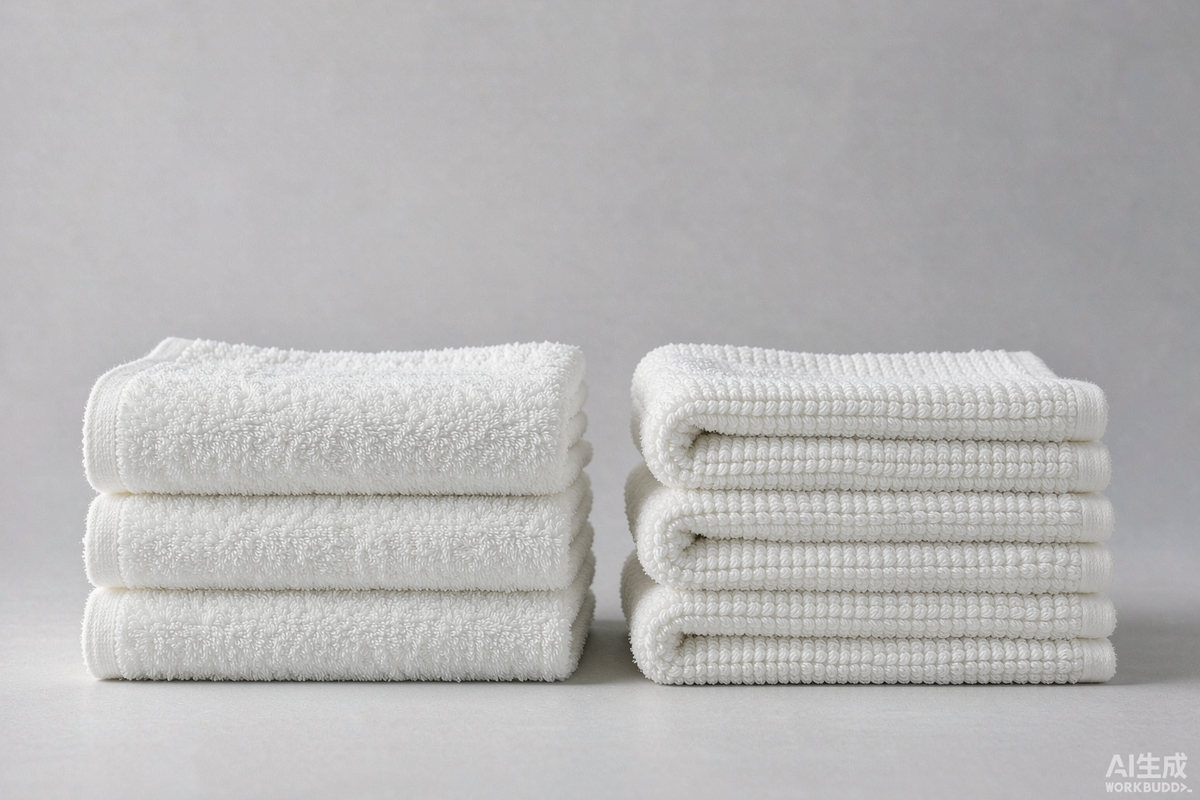
A buyer comparing towel quotes sees the same 600 GSM, the same 70 x 140 cm, the same white, and a zero-twist line quoted at the top of the sheet. The spread is real, but it is not a quality gap. Zero-twist is a different construction, and it wins on exactly one axis: the first few seconds against the skin. Whether that is worth paying for depends on two things you already control - how many times your laundry will wash the towel, and how well your building dries it. Get those wrong and zero-twist becomes the most expensive towel in your programme, not the best.
What Actually Changes When You Remove the Twist
Terry yarn is normally twisted before weaving, and that twist is what gives the pile its strength. Zero-twist goes the other way: the yarn is spun with almost no twist and held together by a soluble binder that is washed out during finishing. What is left is loose, open fibre.
Two consequences follow every time.
- Faster absorbency. Open loops expose more fibre surface, so a zero-twist towel takes water faster than a twisted towel at the same weight.
- Lower structural strength. Twist is what holds fibres together. Without it, the pile has less tensile strength, sheds more lint when it is new, and snags more easily.
No finishing process reverses the second point. A supplier who says their finishing "fixes" durability is describing a softened box, not an engineered towel.
One material condition matters more than any sales claim: genuine zero-twist needs long-staple cotton. Short-staple fibre cannot be spun this loose and still hold a loop. If someone quotes you zero-twist at a rock-bottom price, the first question is which cotton grade is behind it - and Xinjiang long-staple or an equivalent origin is the answer you want.
The Three Towel Constructions, Side by Side
Judge a towel on construction first, then weight. These are the three constructions you will actually be quoted, and they do not compete on the same axis.
| Factor | Zero twist | Combed ring spun | Standard ring spun |
|---|---|---|---|
| Yarn structure | Open, almost no twist | Tight twist, short fibres removed | Tight twist, all fibres kept |
| Hand feel, day one | Softest available | Very good | Good |
| Absorbency | Fastest | Good | Good |
| Snagging and pilling | Highest risk | Low | Low |
| Drying in humid air | Slowest, bulky water-hungry pile | Faster | Faster |
| Industrial wash life | Shortest of the three | Longest at a given weight | Long, best value in hard use |
| Cost per piece | Highest | Moderate | Lowest |
| Right application | Suites, villas, spa rooms, retail | 4-5 star guest rooms, towel programmes | Gyms, pools, budget, high volume |
The step most buyers skip is combing. Combed ring spun removes the shortest 15 to 20 percent of fibres before spinning - exactly the fibres that shed as lint in a towel's first 15 to 20 washes. Combing also makes the yarn stronger at the same weight, because short fibres are weak points. That is why combed ring spun, not zero-twist, is the default answer for most towel programmes.
Who Should Buy Zero-Twist, and Who Should Not
Zero-twist is the right purchase in a narrow set of places, and the wrong purchase in a wider one. This is the split, as we quote it.
| Property or channel | Verdict | Why |
|---|---|---|
| Luxury suites, villas, pool villas | Buy | The guest is meant to notice the towel, and wash frequency is moderate |
| Spa treatment rooms | Buy | Low wash frequency, gentle cycles, hand feel is the product |
| Retail and gift programmes | Buy | The customer judges by touch before buying |
| 4-5 star guest rooms, standard floors | Usually skip | Combed ring spun at 500-600 GSM looks the same at wash 200 |
| Budget and select-service hotels | Do not buy | Replacement cost outweighs the first-touch gain |
| Gyms, pools, salons | Do not buy | A busy gym runs 250 to 400 wash cycles a year on hot, sanitising programmes |
| Hospitals and care facilities | Do not buy | Hot washes plus bleach; the pile will not survive them |
The pattern is simple. Zero-twist is bought to be noticed and washed gently. Ring spun is bought to be washed hard and replaced on a schedule. A property that runs both - zero-twist in suites, combed ring spun on standard floors - is not being inconsistent. It is matching the towel to the wash load.
Two Site Conditions That Override Your Star Rating
Humidity. Zero-twist holds moisture longer than ring spun. In Singapore, the Maldives, coastal Southeast Asia, the Gulf or Florida, it will not dry between uses, and a damp towel in a guest bathroom turns into a smell complaint. Specify ring spun regardless of the star rating.
Hard water. Across much of the Gulf, parts of Saudi Arabia, the US Southwest and Texas, and anywhere on desalinated supply, calcium deposits lodge inside the pile. A zero-twist pile stiffens faster under deposit and does not recover. Ring spun does.
Need these specs quoted for your property?
Tell us your hotel tier, quantities and timeline — get a free, no-obligation quote within 24 hours.
If you are sourcing for a portfolio that spans Dubai and a Scottish country house, do not write one towel specification. Write two.
What Zero-Twist Costs from a Dieshiqiao Towel Line
Towels in this programme are made by the alliance's towel specialist member factory, not the bedding mill. The same rule applies here as everywhere in the manufacturer alliance of FOB export factories: the factory that takes your order owns and operates its own production facility, holds its own export licence and can invoice FOB in its own name, accepts buyer audits and on-site visits, and works to the alliance's written specification and inspection standard.
Price. For reference, published 2026 export price lists put a mid-range 600 GSM bath towel around USD 2.80-3.50 per piece at 500 pieces, and 650-700 GSM ultra lines at USD 3.80-5.00. Zero-twist sits at the top of the construction tiers, above combed ring spun, which sits above standard ring spun. The yarn alone accounts for the step, because zero-twist can only be spun from long-staple cotton.
Weight. Specify 500-650 GSM for zero-twist bath towels. Heavier is not better here: a 700 GSM zero-twist towel compounds the drying problem without adding meaningful absorbency.
Minimum order. 200 pieces per size and colour combination for towels, with trial orders from 50 pieces. Embroidery and dobby borders are quoted separately, and embroidery generally wants a larger run to justify the setup cost.
Lead time. Bulk production runs 20-30 days from artwork and colour approval, plus 7-10 days in the August to November peak. Samples run 5-7 days, and 7-10 days where dyeing or embroidery is involved. Colour approval is the single most common cause of delay; approve the lab dip before you approve anything else.
Read the Sample the Way Your Laundry Will Treat It
Feeling a towel in a showroom tells you almost nothing, because a softener finish makes any towel feel good for exactly as long as the finish lasts. Do this instead.
- Wash the sample three times at your own laundry's settings - your temperature, your chemicals, your tumble dryer.
- Check the lint trap each time. A combed towel gives visibly less lint by the third wash. Zero-twist will keep shedding.
- Snag test. Run a fingernail across the pile. Zero-twist loops pull; ring-spun loops resist.
- Look at the hem, not the pile. The most common reason a commercial towel is discarded is a hem that came apart in an industrial dryer while the pile was still good. Specify a double-stitched hem and inspect it on the sample.
Count cost per use, not cost per piece. A towel at USD 4.00 that survives 250 industrial washes costs about USD 0.016 per use. A towel at USD 3.00 that dies at 100 washes costs USD 0.030. The cheaper towel is nearly twice as expensive.
The Decision Rule
If the towel is bought to be noticed and washed gently, buy zero-twist. If it is bought to be washed hard and replaced on a schedule, buy combed ring spun at 500-600 GSM and spend the saving on a second towel per room.
Write the specification with all three variables locked: yarn, weight, hem. One out of three is not enough, and an unstated hem is the most common reason a towel programme fails on cost per use rather than on quality.
The alliance runs on one contract, one spec sheet, one inspection standard and one set of shipping documents. The member factory that makes your order is named on the contract and ships under its own export licence, and you can visit it before you commit.
This article was written for hotel linen buyers sourcing from China. For custom hotel linen inquiries, visit nantonglinens.com.
Shop Related Products
Free PDF: Complete Hotel Linen Buying Guide
Step-by-step procurement guide covering specs, MOQ, pricing, QC, and shipping — based on real Dieshiqiao experience.
Need help sourcing hotel linens?
Get a free quote within 24 hours. No commitment required.
Request a QuoteRelated Articles
Pre-Shrunk vs Sanforized Hotel Sheets: What to Write in the PO
Sanforized and pre-shrunk are not the same promise. What each one actually certifies, what your laundry really does, and the lines to add to the PO.
Towel Pile Height vs Terry Weight: Why 600 GSM Feels Different
Two 600 GSM hotel towels can feel completely different. Here is how pile height drives feel, drying and wash life, and the two specs to lock in writing.
Air-Jet vs Rapier Weaving: What Changes in Hotel Sheets
Both loom types make hotel sheets, but the one your mill runs decides weft stop marks, yarn tolerance, price and cut width. Here is what to ask.