Hotel Linen Quality Control Checklist: What to Inspect Before Shipment
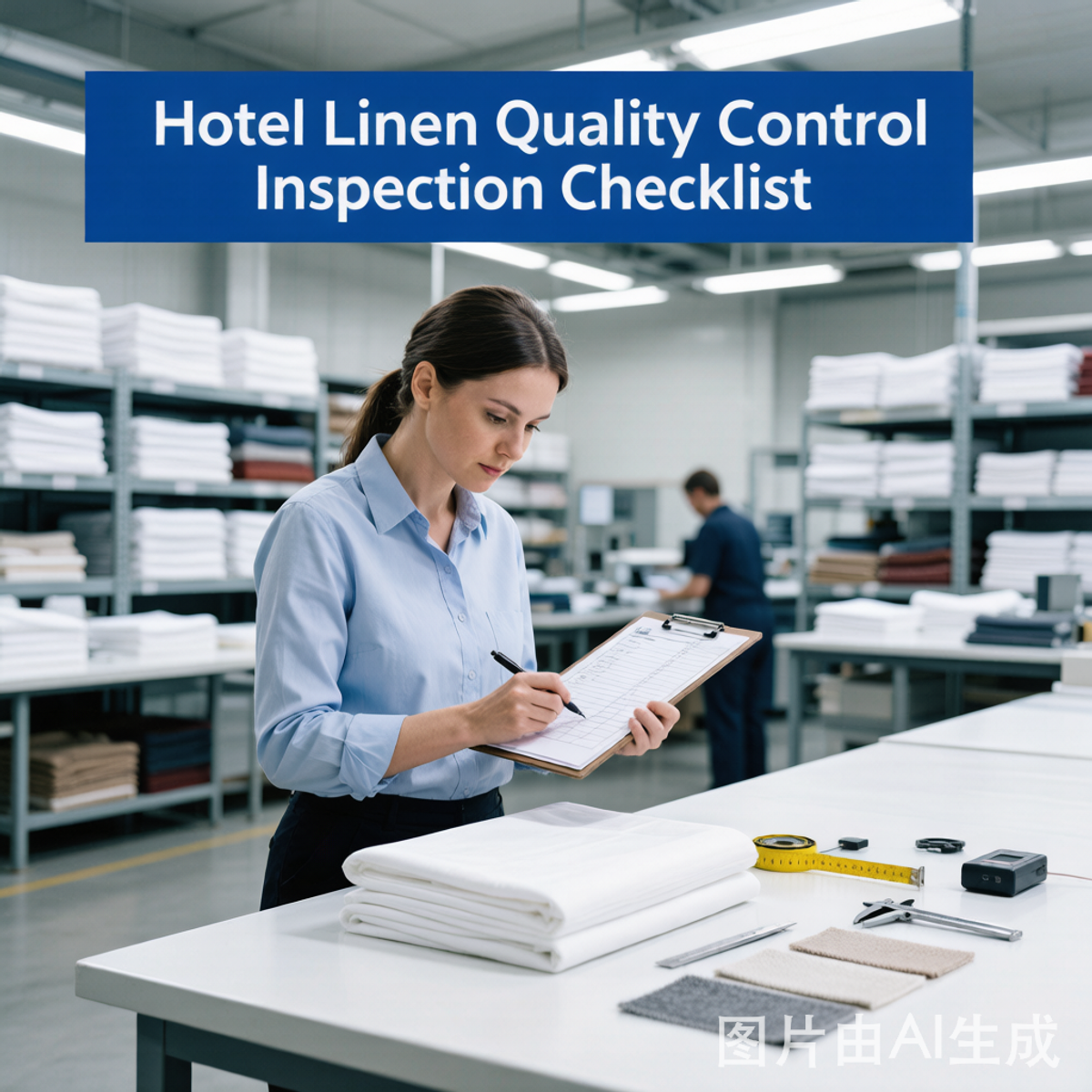
You've negotiated the price, approved the sample, and your order is in production. Now comes the step that separates professional buyers from amateurs: quality control.
Without proper QC, you'll discover problems when your shipment arrives — and by then, the factory has been paid and your guests are waiting. This checklist covers exactly what to inspect at each stage, based on real-world QC practice in Chinese textile factories.
The 3-Stage QC Process
Professional buyers use a three-stage inspection process. Each stage catches different types of problems at the point where they're cheapest to fix.
Stage 1: Pre-Production Inspection (PPI)
Timing: Before cutting begins. What to check:
☐ Raw fabric rolls — verify GSM/weight with a fabric GSM cutter and scale. Tolerance: ±5% of spec.
☐ Fabric composition — request fiber content test certificate (OEKO-TEX, SGS, or Intertek). Verify the label matches the test.
☐ Color matching — check dye lot against approved lab dip under D65 standard lighting. Minimum: visual check. Ideal: spectrophotometer reading (Delta E < 1.0).
☐ Colorfastness — request wash/rub test report. Minimum grade: 4 (out of 5) for washing, 3-4 for rubbing.
☐ Shrinkage test — fabric should be pre-shrunk or tested for expected shrinkage. Max 3-5% for cotton, < 2% for poly-cotton.
☐ Thread/yarn inspection — check for consistent thickness, no broken filaments, correct twist.
Red flag: If the factory can't show you the raw materials or test certificates, stop. Do not proceed to production.
Stage 2: In-Production Inspection (DPI / DUPRO)
Timing: When 20-30% of production is complete. What to check:
☐ Stitching quality — seam strength, stitch density (8-12 stitches per inch for bed linen), no skipped stitches.
☐ Dimensional accuracy — measure random pieces against spec. Tolerance: ±2% for length/width.
☐ Hemming — even width (typically 2-5cm for sheets), no twisting, clean corners.
☐ Selvedge / edge finishing — properly finished, no fraying or loose threads.
☐ GSM/weight of finished product — random sampling with fabric scale. Should match approved PPS.
☐ Color consistency within batch — no visible shade variation between pieces.
☐ Label attachment — care labels, size labels, brand labels: correctly placed, correct information.
At this stage, you're looking for systemic problems — issues that affect the entire batch, not just one piece. If you find them here, only 20-30% of production needs rework.
Stage 3: Pre-Shipment Inspection (PSI / FRI)
Timing: When 80-100% of the order is produced and packed. This is your final checkpoint before the goods leave the factory. What to check:
AQL Sampling Standard
Use AQL (Acceptable Quality Limit) table to determine sample size:
Order Quantity | Sample Size (AQL 2.5) | Max Major Defects | Max Minor Defects
91-150 pcs | 20 pcs | 1 | 2
151-280 pcs | 32 pcs | 2 | 3
281-500 pcs | 50 pcs | 3 | 5
501-1200 pcs | 80 pcs | 5 | 7
1201-3200 pcs | 125 pcs | 7 | 10
Major defects (AQL 2.5): Anything that makes the product unusable or unacceptable to a guest — holes, stains, severe size deviation, missing labels, broken stitching.
Minor defects (AQL 4.0): Cosmetic issues that don't affect function — slight color variation, minor thread ends, light creasing.
Full PSI Checklist
☐ Visual inspection on inspection table under adequate lighting (750-1000 lux).
☐ Fabric defects — holes, snags, stains, oil spots, slubs, yarn irregularities. Check both sides.
☐ Stitching defects — skipped stitches, broken seams, loose threads, uneven hems.
Need these specs quoted for your property?
Tell us your hotel tier, quantities and timeline — get a free, no-obligation quote within 24 hours.
☐ GSM verification — cut and weigh random samples. Industrial GSM cutter + calibrated digital scale.
☐ Color verification — compare against approved PPS under D65 light source.
☐ Label and tag verification — correct information, correct placement, correct language.
☐ Packaging check — correct polybag size, correct folding, correct carton marking.
☐ Carton drop test (optional) — drop a carton from 1m height. Contents should be undamaged.
☐ Quantity verification — count cartons, verify packing list against order.
☐ Photo documentation — photograph any defects found, the inspection process, and representative samples.
Common Defects to Watch For
Defect | Description | Severity
Shading / Color variation | Different dye lots mixed; visible color difference between pieces | Major
Slubs / thick places | Irregular thick sections in yarn creating bumps in fabric | Minor to Major (depends on size/quantity)
Holes / tears | Any hole in the fabric | Critical — reject
Stains / oil spots | Gray or yellow spots from machine oil or handling | Major (any stain is unacceptable for white hotel linen)
Size deviation >3% | Sheet or towel significantly off-spec in dimensions | Major
GSM underweight >5% | Towel lighter than specified by more than 5% | Major
Skipped stitches | Gaps in stitching, especially on hems | Major
Twisted hem | Hem does not lay flat, twists along the edge | Minor to Major
Loose threads | Uncut thread ends longer than 1cm | Minor
Creasing / folding marks | Deep creases from packaging | Minor (usually resolves in first wash)
What a Professional QC Report Should Include
If you're using a sourcing agent who claims to do QC, hold them to this standard. A proper QC report includes:
1. Date, time, factory name and address
2. Inspector name and contact
3. Order reference and product description
4. Sampling plan (AQL level, sample size, lot size)
5. Inspection results with defect classification and count
6. Measurement table (spec vs. actual for each measured piece)
7. GSM test results with photos of the measurement process
8. Photos of every defect found (with ruler for scale)
9. Photos of the inspection environment and process
10. Overall pass/fail result with actionable recommendations
A report that says 'all good' with two blurry photos is not QC — it's a rubber stamp. Demand detail.
What If the Inspection Fails?
If the PSI fails (defects exceed AQL limits), you have options:
Option A — 100% re-inspection: Factory sorts through every piece, removes defects, re-presents for inspection. Adds 3-7 days.
Option B — Rework: Factory repairs correctable defects (re-stitching, re-pressing). Adds 5-10 days.
Option C — Price reduction: Accept the lot as-is with a negotiated discount (typically 5-15% for minor quality issues). Only do this if defects are cosmetic and won't affect guest experience.
Option D — Rejection: Cancel the order. Last resort, and your contract should specify rejection conditions and deposit return terms.
This is why you never pay the full balance before passing PSI. Standard payment terms (30% deposit, 70% after passing inspection) protect you here.
Shop Related Products
Free PDF: Complete Hotel Linen Buying Guide
Step-by-step procurement guide covering specs, MOQ, pricing, QC, and shipping — based on real Dieshiqiao experience.
Need help sourcing hotel linens?
Get a free quote within 24 hours. No commitment required.
Request a QuoteRelated Articles
Hotel Linen Color Consistency QC: Dye Lot Management & Inspection Standards
Dye lot variation is one of the most common hotel linen quality complaints. Learn lab dip approval, Delta E measurement, light box testing, AQL sampling, and color QC protocols.
Hotel Bathrobe Quality Inspection: Terry, Velour & Waffle Weave Standards
QC checklist for hotel bathrobes: fabric weight comparison (terry vs velour vs waffle), belt and pocket construction, embroidery quality, and sizing verification.
Hotel Bed Sheet Quality Inspection Checklist: From Fabric to Packaging
Complete QC checklist for hotel bed sheets: fabric weight, stitch quality, shrinkage, color fastness, and packaging standards. Ensure every shipment meets spec.