Towel vs Bedding Production Capacity: Why Bedding Orders Slip First
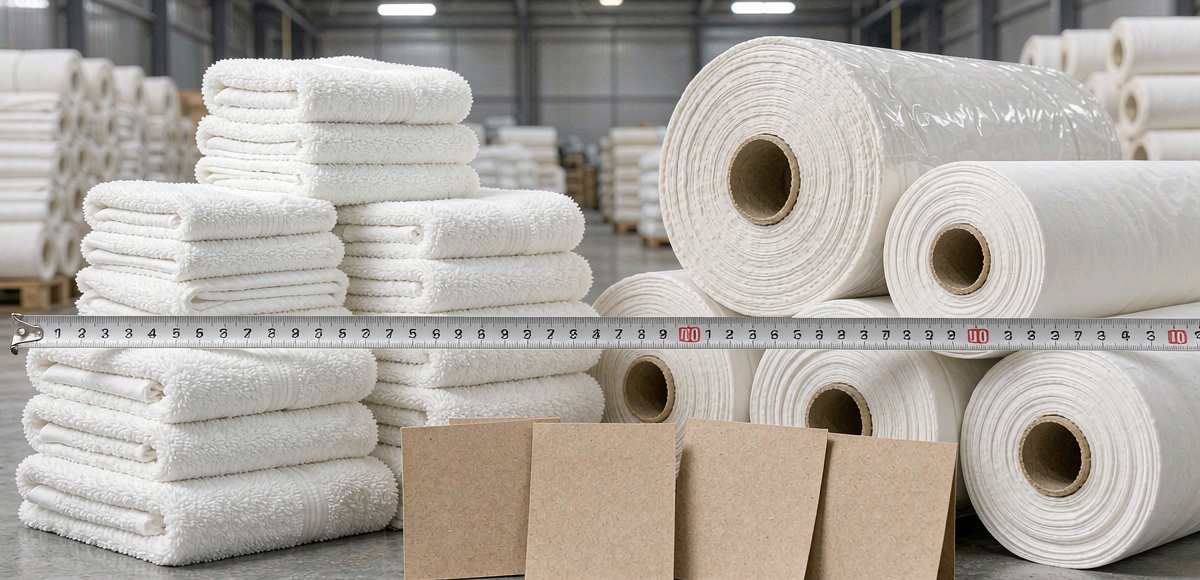
You asked for towels and bedding in the same shipment and got two dates: 25 days for the towels, 35 for the bedding. Then the towels shipped on day 26 and the bedding slipped to day 42. That pattern repeats on almost every mixed order leaving Dieshiqiao, and it is not a discipline problem. Towel capacity and bedding capacity are measured in different units - pieces on one line, meters on the other - and the two clocks run on different constraints. Knowing which one governs your order tells you in advance which date will move.
Two Different Bottlenecks: Pieces Versus Meters
A towel factory measures capacity in pieces per day: how many towels can be woven, cut, hemmed, labeled, inspected and folded in a shift. A bedding factory measures capacity in meters of fabric off specific loom widths, then in cut-and-sew output. The two systems respond to different variables. Raising towel GSM from 400 to 600 barely changes handling time, because every piece gets touched the same way. Raising sheet weight barely changes loom time either, because weaving speed is set by pick density, not fabric weight. But piece count, fabric width and color count affect the two lines very differently - and that is where the dates diverge.
The Towel Line: Every Piece Gets Touched
After the terry loom, each towel passes through the same sequence: cut from loom state, hemmed, woven label attached, inspected, folded, poly-bagged. A 400 g bath towel and a 650 g one take almost identical handling time, which is why a heavier towel does not cost you weeks. What costs weeks is pieces and sizes.
The math is simple: doubling order quantity roughly doubles finishing time, while doubling GSM changes almost nothing. Size count matters more than buyers expect, because each size is a separate cutting and labeling run. Standard minimums reflect this: white towels from 200 pieces per size, dyed-to-match colors from 1,000 pieces per color - a colored towel needs its own dyebath regardless of quantity. One practical consequence: a 3,000-piece order across 12 sizes takes longer through finishing than 3,000 pieces in 3 sizes, even though loom time is identical.
The Weaving Shed: Width and Picks Set the Clock
Fabric loom output is picks per minute. Modern air-jet looms typically run above 1,000 picks per minute and rapier looms around 600 to 750, so a plain sheeting construction moves fast in machine terms. The bottleneck is not speed - it is availability of the right width.
A King flat sheet with a 280 cm finished width needs greige at roughly 290 to 295 cm to allow for shrinkage and hemming. Wide-width looms are a minority of installed capacity, and they also serve curtains, tablecloths and fashion widths. Standard-width greige is often on the shelf; 290 cm-plus greige is usually woven to order, with weaving mills commonly quoting 30 to 45 days for bulk greige and 55 to 60 days for special constructions, often with a minimum around 3,000 meters per weave.
This is why bedding lines quote 25 to 35 days and sheet sets 30 to 40 days while towels sit at 20 to 30: a set needs up to four different greige constructions - flat sheet, fitted sheet, duvet cover, pillowcases - and the set only ships when the last one finishes.
Why Bedding Orders Slip First
Bedding carries five compounding weaknesses that towels do not:
- Width competition. Your 3,000-meter wide-width order queues behind larger runs on the same looms.
- Higher cost of a cutting error. A mis-sized towel becomes a rag; a mis-cut 290 cm panel is expensive wide greige in the bin, so mills re-check and re-cut, and that caution costs days.
- Sets multiply components. Four constructions per set mean four chances for one late item to hold the whole shipment.
- Shorter runs per loom. Wide-width batches are smaller and changeovers more frequent, so peak-season queues build faster.
Need these specs quoted for your property?
Tell us your hotel tier, quantities and timeline — get a free, no-obligation quote within 24 hours.
- Dyehouse width limits. Fewer dye and finishing lines run 290 cm-plus widths, so bleaching and dyeing calendars are tighter.
In the August to November peak we add 7 to 10 days across the board - and because bedding sits later in every queue, it absorbs the peak twice: once in weaving, once in finishing.
What Actually Moves Each Clock
| Variable | Towels | Bedding |
|---|---|---|
| GSM / weight | Barely matters - handling time per piece is the same | Barely matters - loom speed follows pick density |
| Order size in pieces | Linear driver - finishing time scales with piece count | Weak - meters drive weaving, not pieces |
| Fabric width | Fixed terry widths, widely available | Hard constraint - King needs 290-295 cm greige, often made to order |
| Number of colors | Separate dyebath per color (1,000 pcs minimum) | Separate greige and dye run per color |
| Components per order | One item per SKU | A set needs up to four greige constructions |
| Typical normal-season lead time | 20-30 days | 25-35 days; sets 30-40 days |
How to Schedule a Mixed Order Around It
Treat the two categories as two schedules that share a vessel, not one schedule:
- Get greige status before anything else. Ask whether King-width greige is on the floor or woven to order. This single answer predicts most bedding delays.
- Set two ready dates, not one. Towels and bedding will differ by 5 to 10 days by design; pretending otherwise guarantees a slipped date.
- Freeze sizes and widths at spec approval. Every width change re-triggers weaving at 30 to 45 days.
- For sets, demand per-component dates. The set ships when the last component clears inspection, so track the weakest one.
- Book inspection against the bedding date. Third-party inspection typically needs 5 to 7 working days' notice, longer in peak season; booking it after the towel date wastes the gap.
How the Alliance Handles Both in One Order
Every member factory of our alliance owns and operates its own production facility, holds its own export licence and invoices FOB in its own name, accepts buyer audits and on-site visits, and works to the alliance's written specification and inspection standard. Towels come from member factories that run their own finishing lines; bedding comes from our founding member's 5,000 m bedding mill in Chuanjiang Town, which you can walk before you commit (see our factory page).
Because the alliance runs one contract, one spec sheet, one inspection standard and one set of shipping documents across categories, the two ready dates still reconcile into one shipment - the member factory that makes each order is named on the contract and ships under its own licence.
The next time you compare quotes, ask each mill two questions: how many pieces per day does the towel finishing line clear, and is King-width greige stock or made to order? The answers will tell you which order slips before either date is quoted.
This article was written for hotel linen buyers sourcing from China. For custom hotel linen inquiries, visit nantonglinens.com.
Shop Related Products
Free PDF: Complete Hotel Linen Buying Guide
Step-by-step procurement guide covering specs, MOQ, pricing, QC, and shipping — based on real Dieshiqiao experience.
Need help sourcing hotel linens?
Get a free quote within 24 hours. No commitment required.
Request a QuoteRelated Articles
What Delays Hotel Linen Orders: Seven Causes, Ranked by Days
Most hotel linen orders ship late because a decision sat unresolved, not because a machine stopped. Seven causes, ranked by the days each one costs.
Rush Hotel Linen Orders from Dieshiqiao: What 15 Days Costs
Which hotel linen rush orders Dieshiqiao can truly compress to 15 days, what the premium pays for, and why air freight can cost more than the towel.
Sample Lead Time vs Production Lead Time: Why 7 Days Becomes 45
A sample takes 7 days; bulk quotes 25-35. Not padding — the sample ran on shortcuts, and four sample-stage decisions decide where bulk production slows.