RFID & Smart Linen Tracking: The Future of Hotel Textile Management
The Current State: Blind Management
If you asked most hotel operators how many bed sheets they actually have in circulation right now, they couldn't give you a confident answer. They know what was ordered last quarter. They know the last manual count. But between laundry, rooms, storage, and the discard bin, the real number is anyone's guess. Industry data shows annual linen shrinkage rates of 15-20% are common — and most hotels treat this as an unavoidable cost of doing business.
Manual inventory counts — housekeeping staff walking every room and storage area with a clipboard — remain the standard in most properties. These counts take 2-3 days for a 200-room hotel, achieve roughly 85% accuracy at best, and are outdated the moment they're completed. This is not a criticism of hotel operations. It's a recognition that the industry has never been given better tools. Until now.
How RFID Linen Tracking Works
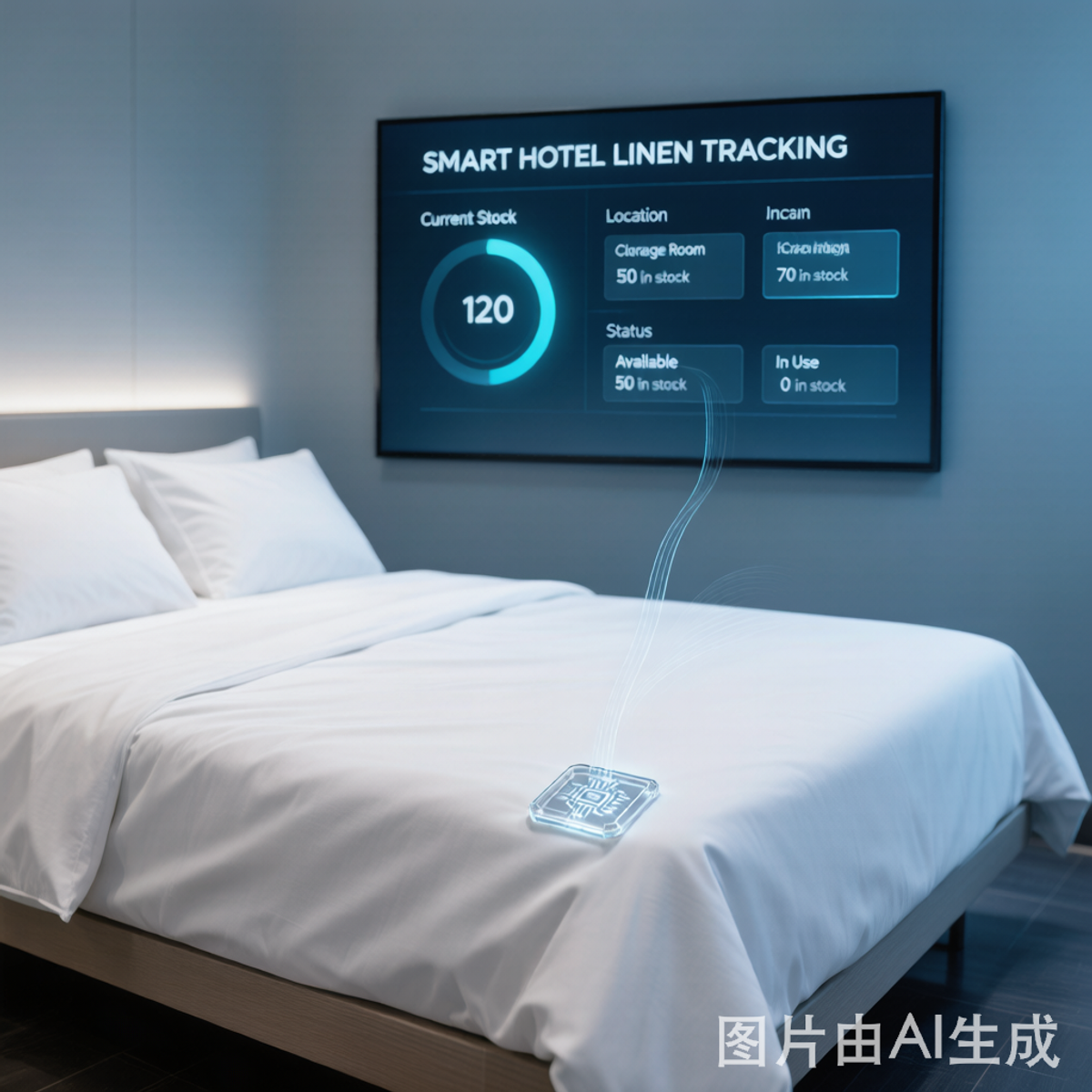
Each linen item — every sheet, towel, duvet cover, bathrobe — receives a small RFID (Radio Frequency Identification) tag sewn into a seam or hem. These tags are the size of a clothing care label, fully washable (rated for 200+ industrial wash cycles), and contain a unique identifier. Stationary RFID readers at key chokepoints (laundry intake, storage room entrance, floor distribution carts) and handheld readers for spot checks capture item-level data in real time.
The system answers questions that manual methods cannot: How many wash cycles has this specific sheet gone through? Is this towel approaching end-of-life based on cycle count? Did 30 pillowcases go missing between laundry and floor 4 this week? Which supplier's batch is failing faster than others?
The ROI Calculation: Why RFID Pays Back
The upfront investment in RFID tagging is real: roughly $0.50-1.50 per tag depending on volume and tag type, plus reader hardware ($2,000-10,000 for a mid-size property) and software integration. For a 200-room hotel at 3-PAR, tagging the entire linen inventory of roughly 15,000-20,000 items costs $15,000-25,000 in tags plus hardware.
Need these specs quoted for your property?
Tell us your hotel tier, quantities and timeline — get a free, no-obligation quote within 24 hours.
The payback comes from multiple sources: (1) Shrinkage reduction from 15-20% to 3-5% — for a hotel spending $80,000/year on linen replacement, that's $10,000-12,000 annual savings. (2) Elimination of manual inventory labor — 2-3 staff days per count, 4-6 times per year = $3,000-5,000 annual savings. (3) Optimized procurement — item-level lifecycle data enables precise reorder timing and batch-level supplier performance comparison. (4) Reduced emergency orders — no more rush purchases because inventory count was wrong. Combined, a typical midscale-to-upscale property achieves full ROI within 18-24 months.
RFID Requirements When Sourcing from China
For international buyers, the critical question is whether RFID tags should be applied at the factory or after delivery. Factory application is strongly preferred for several reasons: Chinese manufacturers can sew in tags during production at minimal incremental labor cost (typically $0.10-0.20 per item). Factory-applied tags are integrated into seams rather than added externally, which is more durable. And factory tagging enables batch-level tracking from day one of the item's lifecycle.
When specifying RFID-tagged linen in your procurement RFQ to Chinese suppliers, include: (1) Tag format — UHF (860-960 MHz) is standard for hotel linen tracking. (2) Wash durability rating — minimum 200 cycles at 75°C. (3) Tag placement — specify seam location (typically bottom hem of flat sheet, inside seam of pillowcase, corner of towel). (4) Encoding format — GS1 SGTIN-96 or custom numbering scheme. (5) Pre-encoding — supplier encodes tags with your property IDs before sewing, or ships blank for your encoding.
Common RFID Adoption Pitfalls to Avoid
The biggest mistake is partial implementation — tagging some linen but not all, which creates two inventory systems and defeats the purpose. Commit to full-tagging from day one. Second mistake: choosing tags rated for insufficient wash cycles. Hotel conditions demand 150-200 cycle minimum rating; cheaper 50-cycle tags will fail prematurely and create tracking gaps. Third: not training housekeeping and laundry staff on how RFID changes their workflows. The technology requires behavioral changes, and staff who understand the why of RFID tracking are far more cooperative than those who see it as surveillance.
The Strategic Advantage
RFID transforms linen management from a fixed operational expense to a manageable, optimizable asset. For the first time, hotels can calculate true cost per item, per wash cycle, per room night — and benchmark those metrics against the market. Properties that adopt RFID now gain a 2-3 year operational advantage over competitors still counting sheets with clipboards. And for procurement managers, RFID data provides the negotiating leverage of hard numbers: this supplier's sheets last 185 cycles; that supplier's fail at 120. The difference justifies the price premium.
Shop Related Products
Free PDF: Complete Hotel Linen Buying Guide
Step-by-step procurement guide covering specs, MOQ, pricing, QC, and shipping — based on real Dieshiqiao experience.
Need help sourcing hotel linens?
Get a free quote within 24 hours. No commitment required.
Request a QuoteRelated Articles
Reactive vs Pigment Dyeing for Hotel Linen: Fastness and Cost
Both look identical in a sample. The dye class decides whether colored hotel linen survives chlorine and 60 C laundering, and who pays when it does not.
Ring-Spun vs Combed vs Carded Cotton for Hotel Bedding
Carded, ring-spun and combed cotton sit on three price steps. Here is what each step buys in a hotel sheet, and when the upgrade is wasted.
China's New Green Textile Standard: What Hotel Linen Buyers Must Know
China's GB/T 35611-2024 green textile standard took effect October 1. Here's what the new low-carbon and chemical limits mean for hotel linen buyers.