Bamboo, Tencel and Lyocell Hotel Linen: Supply, Cost, Laundry Reality
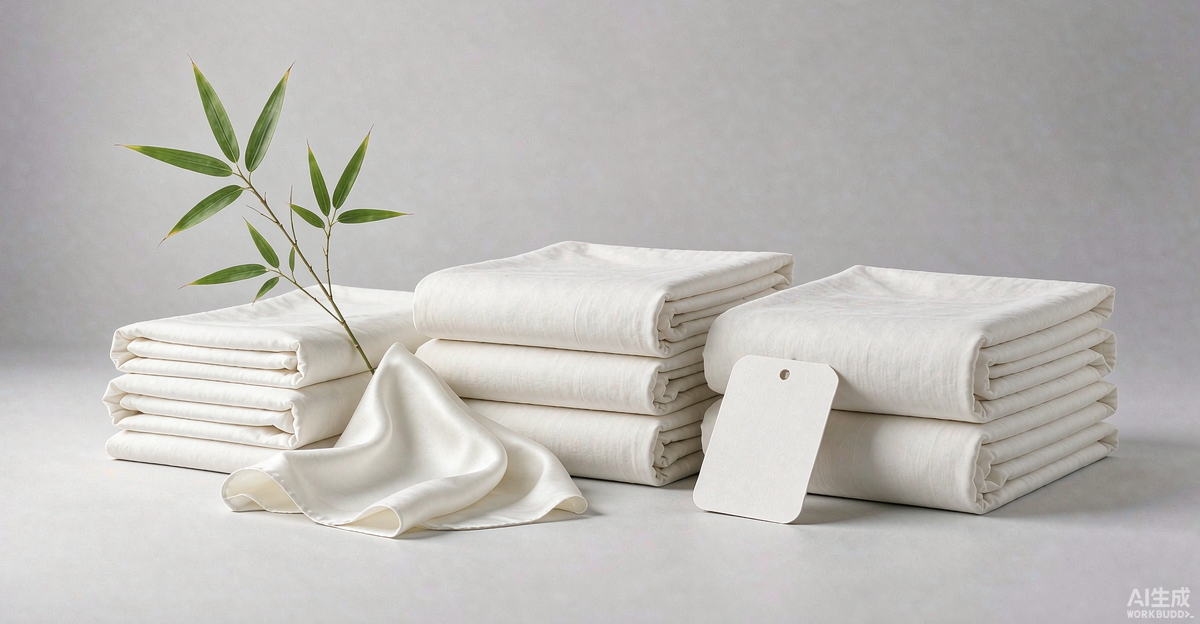
A buyer comparing quotes for bamboo sheets against Tencel sheets is usually comparing three different fibers under two marketing names. The price gap is real, but it is driven by fiber brand, blend content and yarn count, not by the word printed on the label. This article covers what mills around Dieshiqiao can actually supply in 2026, where the price floor sits, and which of the three fibers survives a commercial laundry, so you can decide before samples arrive.
The labeling reality: bamboo and Tencel are not what they sound like
Almost every bamboo hotel sheet on the market is bamboo viscose: regenerated cellulose made by chemically dissolving bamboo pulp, the same family as ordinary viscose. US regulators require such products to be labeled rayon or viscose, because the softness and antibacterial claims attached to raw bamboo do not survive the chemical process. Lyocell is the cleaner cousin in the same cellulose family, spun in a closed-loop amine-oxide system that recovers more than 99% of the solvent.
TENCEL is not a fiber type. It is Lenzing's registered brand for lyocell and modal fibers. Any mill can buy generic lyocell; only authorized mills may sell fabric as TENCEL. In practice this is the single biggest price lever in the category, and it is the first thing to verify: check that the care label reads lyocell rather than a brand word, and ask for the Lenzing hangtag authorization whenever a quote says TENCEL.
Availability from Dieshiqiao in 2026: lyocell is no longer scarce
This used to be a supply-constrained category. It is not anymore. Chinese lyocell production grew from 336,000 tonnes in 2023 to 428,000 tonnes in 2024 and 627,000 tonnes in 2025, and domestic capacity is expected to pass 1.2 million tonnes by the end of 2026, over 60% of global supply. Chinese chemical-fibre market trackers put domestic lyocell fibre quotes at 14,000-15,000 RMB per tonne as of September 2026, with mills reporting shipments tight but available.
For buyers this means two practical things. First, generic lyocell and lyocell-cotton blends, usually 20-30% lyocell in spinning blends, are stock items around Dieshiqiao; lead times are normal, not extended. Second, genuine Lenzing TENCEL fiber is available but moves through authorized mills at a brand premium, so expect a quote difference against generic lyocell even at identical construction. The alliance's bedding factories run both routes, and the founding member's 5,000 sqm bedding mill in Chuanjiang works Lenzing Tencel alongside Xinjiang long-staple cotton.
Minimums follow the standard bedding rules: 100 pieces per size and color for production, 50-piece trial orders accepted, greige minimums around 3,000 metres per weave construction. White samples take 5-7 days, dyed samples 7-10 days; bulk bedding runs 25-35 days, plus 7-10 days in the August-November peak.
2026 price anchors, from fibre to fabric
| Material | Avg. fibre price, USD/kg | Typical range | Note |
|---|---|---|---|
| Viscose staple | 1.55 | 1.35-1.75 | Cheapest cellulosic; weakest wet strength |
| Bamboo viscose | 1.85 | 1.45-2.45 | Viscose process; the premium buys marketing, not laundering life |
| Lyocell (Tencel-type) | 2.40 | 1.90-3.30 | Branded Lenzing TENCEL sits at the top of the range |
| China domestic lyocell | 14,000-15,000 RMB/t | - | September 2026 market quotes; brand premium excluded |
The fibre table explains most quote gaps before you reach fabric. A Tencel quote on Lenzing fiber, 60s yarn and sateen construction is a different product from a lyocell quote on generic 40s fibre: the same words, a different cost base. Judge any comparison on four fields: fiber brand, blend percentage, yarn count and weave. If a supplier will not put all four on the quotation, the prices are not comparable.
The laundry reality: fibrillation is the failure mode
Lyocell is strong when wet, stronger than viscose, but it has one specific weakness in commercial laundry: fibrillation. The fiber swells roughly 50% more than cotton in water, and under mechanical abrasion in that swollen state its surface splits into micro-fibrils. On a sheet this shows up as pilling, a grey or whitened surface, and a harsher hand after repeated high-temperature, high-alkali washes.
This is where generic lyocell and Lenzing TENCEL genuinely differ. Lenzing produces low-fibrillation variants engineered for durability, while generic domestic lyocell varies by producer. Chinese hotel-textile suppliers openly warn that ordinary domestic lyocell greys and pills faster under commercial machine washing, and advise demanding third-party test reports before committing.
Need these specs quoted for your property?
Tell us your hotel tier, quantities and timeline — get a free, no-obligation quote within 24 hours.
Vendor cycle claims for Tencel bedding, commonly 150-200+ washes, assume mild laundering: low temperature, neutral pH, gentle extraction. A 70-85C industrial wash with alkaline detergent is a different environment. Polyester remains the lowest-wear fiber in commercial laundry, which is why most full-service properties keep it in the rotation and confine lyocell to guest-facing sets. The only cycle count that counts is the one your own laundry produces.
Where each material earns its place
| Property type | Recommended route | Why |
|---|---|---|
| Full-service, high occupancy | Poly-cotton or cotton core; Tencel blend for suites only | Fibrillation risk rises with wash frequency; poly-cotton tolerates 70-85C washes |
| Resort, humid climate | TENCEL or Tencel-cotton blend | Moisture management and cool hand are what guests actually notice |
| Boutique, low turnover | Generic lyocell acceptable | Lower wash frequency keeps fibrillation manageable; price matters more |
| Any property on a budget | Skip bamboo viscose | Pays a fibre premium over ordinary viscose for no laundering benefit |
The judgment, stated plainly: bamboo viscose is the weakest buy in this category for commercial use. It prices above ordinary viscose and brings no laundering advantage. Generic lyocell is a cost play that only works when your laundry is gentle. Branded TENCEL is the only version of this fiber family worth writing into a hotel specification for a hard-working house, and even then it belongs in suites, villas and boutique floors before it belongs in a 400-room run.
What to put in the RFQ
- Fiber name and brand on the care label: lyocell, plus Lenzing TENCEL authorization if branded. Reject quotes where the label story is vague.
- Exact blend percentage and yarn count. A 60s sateen and a 40s plain weave are not the same product at any price.
- The wash conditions the quote assumes, in writing: maximum temperature, pH range, extraction strength.
- A third-party pilling test to ISO 12945-2 after a stated number of wash cycles, not on greige fabric.
- A 20-30 set wash trial through your own laundry before the bulk order. Member factories accept trial orders of 50 pieces, so this costs you a sample lead time, not a production slot.
- Standard terms confirmed up front: white samples 5-7 days, dyed 7-10 days, bulk 25-35 days, plus 7-10 days in peak season.
The decision, in one action
Ask two member factories of our alliance to quote the same sheet construction twice: once in Lenzing TENCEL, once in domestic lyocell. Then run both through your own laundry for a month. The price gap you will see is the brand premium; the surface difference after 30 washes is the real answer. Every factory in the alliance owns and operates its own production facility, holds its own export licence and invoices FOB in its own name, accepts buyer audits and on-site visits, and works to the alliance's written specification and inspection standard. Your two quotes therefore arrive on one contract, one spec sheet, one inspection standard and one set of shipping documents, with the member factory that makes the order named on the contract.
This article was written for hotel linen buyers sourcing from China. For custom hotel linen inquiries, visit nantonglinens.com.
Shop Related Products
Free PDF: Complete Hotel Linen Buying Guide
Step-by-step procurement guide covering specs, MOQ, pricing, QC, and shipping — based on real Dieshiqiao experience.
Need help sourcing hotel linens?
Get a free quote within 24 hours. No commitment required.
Request a QuoteRelated Articles
Pre-Shrunk vs Sanforized Hotel Sheets: What to Write in the PO
Sanforized and pre-shrunk are not the same promise. What each one actually certifies, what your laundry really does, and the lines to add to the PO.
Towel Pile Height vs Terry Weight: Why 600 GSM Feels Different
Two 600 GSM hotel towels can feel completely different. Here is how pile height drives feel, drying and wash life, and the two specs to lock in writing.
Air-Jet vs Rapier Weaving: What Changes in Hotel Sheets
Both loom types make hotel sheets, but the one your mill runs decides weft stop marks, yarn tolerance, price and cut width. Here is what to ask.