Dobby, Jacquard or Yarn-Dyed: Hotel Towel Decoration Costs
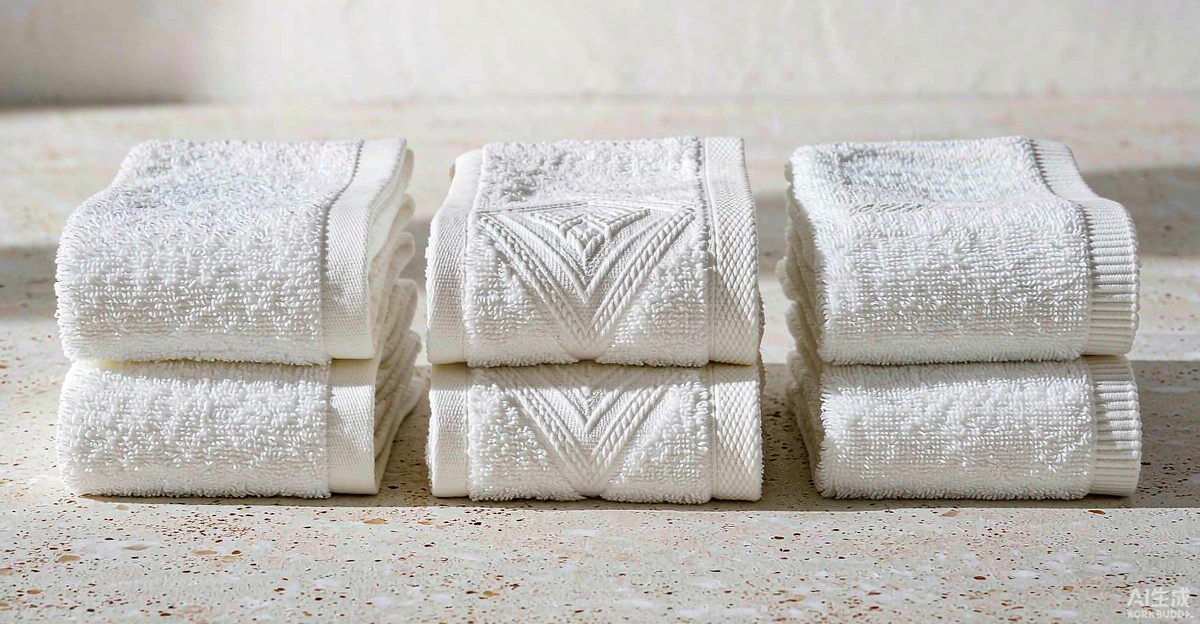
Three quotations for the same 500 gsm, 70 x 140 cm bath towel usually read like this: USD 3.10 with a plain hem, USD 3.45 with a woven border, USD 3.95 with the hotel crest woven in. It looks like one feature at three quality levels. It is not. Each number comes from a different machine, with a different minimum, a different lead-time penalty and a different way of failing after 200 washes. Read them as a ladder and you pay jacquard money for a dobby border.
Two weaving mechanisms and one dyeing decision
A dobby border and a jacquard crest are both woven, but by different shedding systems. A dobby lifts heald shafts: 16 to 24 on the rotary dobbies most towel mills run, up to 30 on technical models, capped at 28 to 32 in the trade literature. Every end threaded into a shaft moves together, so the pattern is built from whole-shaft combinations. The result is a band: rib, check, twill stripe, a small geometric repeat.
A jacquard has no shafts. Each end hangs on its own hook, and hook count caps design width. Machines run from 80 hooks, for a name in a selvedge, to more than 50,000. At a typical 40 ends per centimetre, every 40 hooks buy one centimetre of repeat: a 6 cm crest needs about 240 hooks, a 25 cm hotel name across the towel about 1,000. That arithmetic, not the supplier's confidence, decides whether your mark can be woven at all.
A yarn-dyed band belongs to another category. The loom does not change; the colour goes into the yarn at the dyehouse before weaving. It can sit on a dobby border, a jacquard border or a plain towel, and it is priced on kilograms of dyed yarn rather than loom time. Ask which of the three a supplier is quoting and most will describe the design instead of the machine. That is the first sign the quotes will not compare.
What each option costs and what it demands
These are 2026 FOB ranges for hotel towels at 500 gsm and above. They are ranges on purpose: the same border at 300 pieces and at 3,000 differs by more than the border does.
| Option | Realistic MOQ per design | One-time setup | Added cost per towel | Lead time impact |
|---|---|---|---|---|
| Custom dobby border | 500 - 1,000 pcs | USD 150 - 400, loom | USD 0.10 - 0.30 | +10 to 15 days |
| Woven jacquard crest | 1,000 pcs | USD 100 - 300, file and loom | USD 0.20 - 0.80 | +10 to 20 days |
| Yarn-dyed colour band | Set by dyed yarn weight | Dye lot only | USD 0.05 - 0.20 | +7 to 12 days |
| Logo embroidered after weaving | 100 - 500 pcs | USD 50 - 150, digitising | USD 0.50 - 2.50 | +3 to 7 days |
Read the last two columns against the first. Embroidery has the lowest minimum, the highest per-piece cost, the right trade for a one-off order. A jacquard crest has the highest minimum and a premium that survives volume, so it pays only when the crest is the brand and not a label. A dobby border is the cheapest decoration here and the one most often sold as grander.
Where each minimum actually comes from
For a dobby border the fixed cost is re-threading the loom: frames re-drawn, pattern chain re-pegged, hours of a fitter's time, identical at 500 towels or 5,000. Spread over 5,000 it disappears into cents; over 150 it becomes 30 to 40 per cent of the towel's price, which is why the mill either refuses the order or quotes a number that reads like an insult.
A jacquard crest carries two fixed costs and only one amortises. The first is the design file, one column per hook and one row per pick, plus harness work. The second is loom speed: jacquard shedding is slower than dobby on the same fabric, so the machine makes fewer towels per day for as long as that design runs. Volume spreads the file but never the speed, which is why a jacquard crest still shows a premium at 10,000 pieces while a dobby border flattens by 2,000.
Yarn-dyed is priced in kilograms, so its minimum is a dye lot. Do the arithmetic first. A 70 x 140 cm towel at 500 gsm is 0.98 square metres and about 490 g of fabric; a border 6 cm deep at each end covers 0.084 square metres, roughly 42 g, and if about a third of that band is coloured yarn the towel carries some 14 g of it. Cone-dye batches run from a few kilograms up to 500 kg, so 25 kg is a normal small lot, not a favour.
| Border depth, each end | Coloured yarn per towel | Towels covered by 25 kg |
|---|---|---|
| 2 cm | about 5 g | about 5,000 |
| 6 cm | about 14 g | about 1,800 |
| 10 cm | about 23 g | about 1,100 |
Need these specs quoted for your property?
Tell us your hotel tier, quantities and timeline — get a free, no-obligation quote within 24 hours.
The consequence is blunt: a wide yarn-dyed band drags you to jacquard-sized minimums without jacquard's design capability. Reorder bites harder, because a new dye lot never matches the last one exactly. If the band has to run three years, specify the colour by reference and buy the border yarn in one lot up front, or write a tolerance into the PO and price the risk of two shades meeting in the same linen room.
The fifteen-minute test for a suspect quote
A dobby border sold as jacquard is the commonest upgrade fiction here: a photograph cannot show the difference and the price gap is 20 to 30 per cent. Four questions settle it.
- What is the design repeat width in centimetres, and how many hooks does the machine have? A jacquard supplier answers both without pausing; a dobby supplier improvises on the second.
- Is loom setup a separate line on the quotation? If not, it sits inside the unit price, which is legitimate, but a repeat order must then be cheaper than the first.
- Does the design read identically from the back? Dobby and jacquard are structural, so both faces are woven the same way; print and transfer are surface only.
- Send an unedited photograph of the reverse of the border. This is the request that is hardest to fake.
What survives two hundred commercial washes
Embroidery is the only option applied after weaving, and it fails differently. On terry, density should sit around 4,000 to 6,000 stitches per square inch. Below that the logo looks sparse and the pile shows through; above it the panel turns stiff, puckers in the wash and hardens against a guest's shoulder. Placement matters as much as density: a mark on the dobby border or hem sits outside the absorbent pile, while a crest mid-field puts a low-pile, high-density zone exactly where the towel should dry a face.
Woven decoration has nothing to unravel because it is not thread. A jacquard crest and a yarn-dyed band are the towel's own yarn, so there is no surface dye to crock onto a white sheet in the dryer and the colour ages at the same rate as the body, which is what a laundry manager wants. The trade-off is a pile break: the woven area is flatter, absorbency there is lower, and after 100 washes the border boundary is where the first thin spot appears.
The buying order follows from that. If the mark is a word up to about 8 cm and the order is under 1,000 pieces, dobby border plus embroidery is the correct purchase; a jacquard crest at that volume spends money on a detail nobody sees on the towel rail. If the crest is the brand and you re-order annually, jacquard is the only option that stays identical for the life of the towel, and ten to twenty extra days is the price. Yarn-dyed earns its place when the colour must outlive chlorine bleach cycles and three sets of towels.
One line to add to your next RFQ
The quotes are hard to compare because the RFQ never asked which machine would run the order. Add one line before the next round: state the shedding mechanism, the design repeat width in centimetres, and the hook count of the machine that will weave it. The three numbers then stop being a ladder and become what they always were, three different products.
That is how the member factories of our alliance quote. Each owns and operates its own production facility, holds its own export licence and can invoice FOB in its own name, accepts buyer audits and on-site visits, and works to the alliance's written specification and inspection standard. The member factory that makes your order is named on the contract and ships under its own licence, so a dobby border from one and a jacquard crest from another arrive on one contract, one spec sheet, one inspection standard and one set of shipping documents. Approve border depth and mechanism on a woven sample, fix the coloured yarn allocation if the band is yarn-dyed, then price at your real annual quantity rather than your first order quantity.
This article was written for hotel linen buyers sourcing from China. For custom hotel linen inquiries, visit nantonglinens.com.
Shop Related Products
Free PDF: Complete Hotel Linen Buying Guide
Step-by-step procurement guide covering specs, MOQ, pricing, QC, and shipping — based on real Dieshiqiao experience.
Need help sourcing hotel linens?
Get a free quote within 24 hours. No commitment required.
Request a QuoteRelated Articles
Dieshiqiao Peak Season Calendar: When to Place Hotel Linen Orders
Hotel linen capacity in Dieshiqiao is not spread evenly across the year. A month-by-month calendar of the five squeeze windows, and what to place when.
Hotel Linen Lead Times from China: A Stage-by-Stage Timeline
The 20-35 day quote hides four queues. Elapsed days by stage for towels, bed linen and bathrobes, plus the transit days most quotes leave out.
Why Two Mills Quote Different Prices for the Same 300 TC Sheet
Two mills quote the same 300 TC hotel sheet 30% apart. Yarn, density, width and finishing explain the gap - and tell you which quote to keep.