Why Two Mills Quote Different Prices for the Same 300 TC Sheet
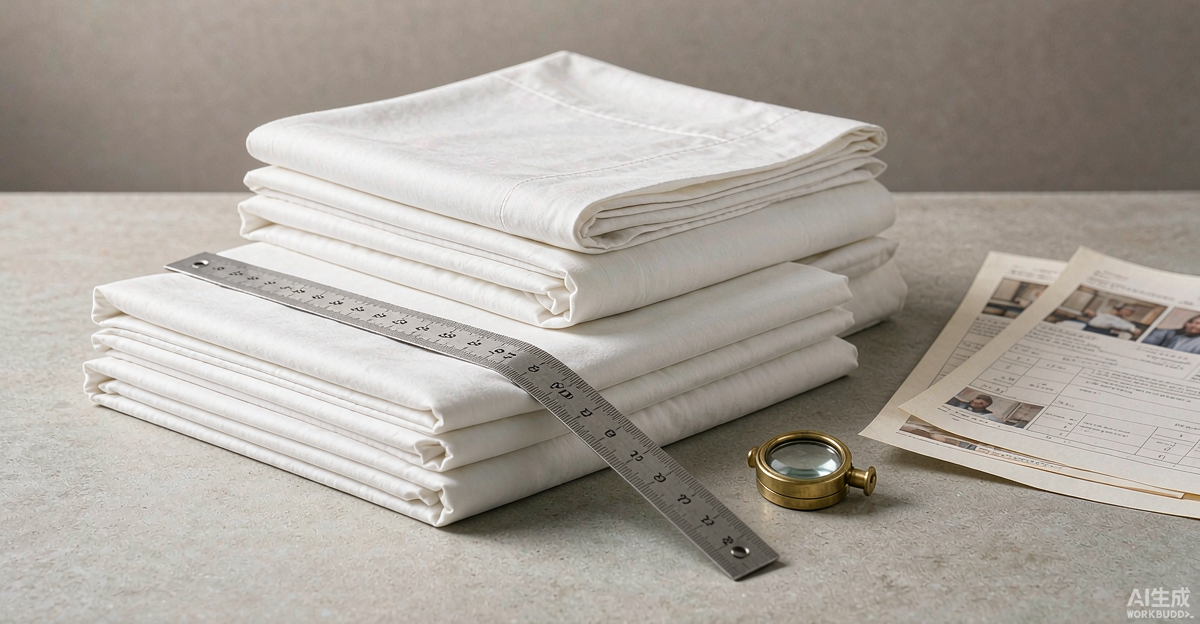
You sent one specification to three mills and got three prices, thirty per cent apart. The instinct is to drop the highest and squeeze the lowest. Do that on a 300 TC sheet and you will usually end up with a different product than the one you thought you were buying. 300 TC is a grade, not a construction - four separate decisions can produce that label. Once you can read those four lines, most price gaps stop being mysterious and start being choices.
300 TC Is a Grade, Not a Construction
Thread count is warp ends plus weft picks in one square inch. ASTM D3775, the test method behind the number, is explicit in section 9.1.4: count individual yarns as single units regardless of whether they are single or plied. ISO 7211-2 says the same in metric. The US Federal Trade Commission addressed the loophole in a 2005 staff opinion: 300 thread count, 2 ply yarn is a defensible label, while calling the same cloth 600 would likely mislead.
That opinion is twenty years old; the practice is still routine in export quoting. A 40s single cloth at 133 ends by 72 picks holds 205 threads per square inch. Reckon the plies separately and it becomes 300 TC on a quotation sheet. A genuine 300 is usually 60s single at 173 by 120, which is 293 threads. Both arrive described as 300 TC, and the gap between them is not a negotiation.
Line 1: Yarn Count Sets a Floor, Not a Ceiling
Yarn prices are published daily, so this line is checkable. On 20 October 2026 the ring-spun complex assessed carded 32s at CNY 22,050 per tonne, carded 40s at 23,330, combed 40s at 24,825 and compact-combed 60s at 27,800 (Mysteel daily yarn assessment). Combed 40s therefore sits about 12 per cent below combed 60s per kilo - but you buy kilos per square metre, not kilos.
| Yarn, ring-spun, 20 Oct 2026 | CNY per tonne | Index vs combed 40s |
|---|---|---|
| Carded 32s | 22,050 | 0.89 |
| Carded 40s | 23,330 | 0.94 |
| Combed 32s | 23,700 | 0.95 |
| Combed 40s | 24,825 | 1.00 |
| Compact-combed 60s | 27,800 | 1.12 |
Work the arithmetic. Greige weight in grams per square metre is about 23.25 x (ends per inch / warp count + picks per inch / weft count). For 133x72 in 40s that gives 119 g/m2; for 173x120 in 60s it gives 114 g/m2. Add six per cent for crimp and two for waste and the yarn inside one square metre costs roughly CNY 3.2 in the first case and CNY 3.4 in the second.
The finer, denser cloth carries about six per cent more yarn cost. Yarn cannot explain a thirty per cent gap. When one quote sits far below the others, the difference is almost always in the next two lines - density and width - or in a lighter cloth travelling under the same description.
Line 2: Density Decides How the Cloth Wears
Two cloths with the same count can differ in tightness, and tightness is what your laundry feels. Peirce cover factor puts a number on it: ends divided by the square root of warp count, plus picks divided by the square root of weft count, minus the overlap term. The 133x72 / 40s cloth lands near 24; the 173x120 / 60s cloth near 25.5. Both are legitimate; they age differently in a tunnel washer, because the second shares the abrasion across more, finer yarns.
Density also carries a cost that never appears on the quotation: loom time. Weaving speed is set by picks per minute, so metres per hour is picks per minute divided by picks per inch and by 39.37. On a wide air-jet loom running around 900 picks per minute, a 120-pick cloth leaves the loom roughly 40 per cent slower per running metre than a 72-pick cloth. Add the extra warping, sizing and end breakage on 173 ends per inch, and the conversion gap is wider than the yarn gap.
The judgement for hotel work: set a finished weight floor instead of a thread count target. Below about 120 g/m2 finished, a 300 TC percale loses tensile strength faster than it loses appearance, and you end up replacing sheets for tears rather than for stains. Above that floor, spend the difference on yarn quality, not on count.
Line 3: Width Changes the Unit of Sale
A mill weaves by the metre and quotes sheets by the piece. The exchange rate between the two is the width. A 280 cm finished flat sheet needs 290 to 295 cm of greige once width shrinkage in finishing is allowed for, which rules out every 240 and 250 cm loom in the cluster. Your quotation can still read 280 cm because the sheet was cut and joined.
Need these specs quoted for your property?
Tell us your hotel tier, quantities and timeline — get a free, no-obligation quote within 24 hours.
Three numbers settle this line: greige width, finished width, panel count. A seamed sheet is not always wrong, but a centre seam is the first thing a commercial laundry fails, and it is invisible on a price list.
The arithmetic is unforgiving. Per running metre, a 300 cm cloth carries 25 per cent more yarn than a 240 cm cloth of the same construction. Piece cost then scales with area: a 280x300 cm flat sheet is 8.4 m2, a 240x280 cm sheet is 6.7 m2 - a quarter less cloth sold under a similar name. Two quotes can sit 25 per cent apart and both be fair, because they are not the same object.
Line 4: Finishing Is Where the Margin Hides
Four finishing passes appear in Chinese sheeting quotes, usually bundled into one line. Mercerizing runs the cloth through caustic under tension: lustre up, tensile strength up by roughly a fifth, dye uptake improved - a full wet pass, and priced as one. Calendering presses the cloth between heated rolls; the glassy surface is largely gone after a few washes. Compressive shrinking, sold under the Sanforized mark when licensed, brings residual shrinkage to about one per cent per direction, and it is the pass that makes a shrinkage clause survivable. Silicone softener improves hand feel, can cost you absorbency, and has mostly washed out by the twentieth cycle.
For hotel white percale the order of value is mercerizing, then compressive shrinking, then nothing. Calendering is a showroom feature; silicone is a retail feature. A quote that is cheaper because it skipped mercerizing is cheaper for a reason you will meet in month eighteen.
Normalizing Three Quotes in One Sitting
Fill the grid below before anyone discusses percentage. It is the grid we use when two member factories quote the same item.
| What the quote says | What it can actually mean | Cost effect |
|---|---|---|
| 300 TC | 205 threads (40s, 133x72) or 293 threads (60s, 173x120) | Yarn +/-6%; density moves loom time up to 40% |
| 280 cm | 292 cm greige, one panel - or 2 x 140 cm joined | The seam is free; the laundry failure is not |
| 100% cotton | Combed or carded, single or two-ply | Combed 40s sits ~6% above carded 40s per kilo |
| Mercerized | A caustic wet pass - or a softener sold as a mercerized hand | Widest single finishing variable |
| Pre-shrunk | Compressive shrinking to ~1% - or a wash with no stated residual | Decides whether your PO clause holds |
Once the grid is filled you are no longer arguing about a percentage; you are choosing between a 205-thread seamed sheet and a 293-thread unseamed one. Send five lines with every RFQ: greige width and finished width; ends and picks per inch; yarn count and ply, stated as single or two-ply; finishing passes, named; a shrinkage and weight test report from the last production run. A mill that cannot answer all five is quoting a grade, not a product.
How We Quote It
The bedding member factory of our alliance - the founding member's 5,000 m2 mill in Chuanjiang - quotes on construction, not on thread count. Ends, picks, yarn count, ply, greige width and the finishing list appear on the quotation itself, because a price without them cannot be compared to anything.
Minimums follow the construction: 100 pieces per specification per colour for bedding, 50 for a trial run, and 3,000 metres per construction if you buy greige by the metre. White samples take 5 to 7 days, a dyed match 7 to 10. Bulk bedding runs 25 to 35 days, and August to November adds 7 to 10 days while the cluster is full.
Every factory in the alliance owns and operates its own production facility, holds its own export licence and can invoice FOB in its own name, accepts buyer audits and on-site visits, and works to the alliance's written specification and inspection standard. The member factory that makes your order is named on the contract and ships under its own licence: one contract, one spec sheet, one inspection standard, one set of shipping documents.
The action is small. Send the four construction numbers with your next RFQ and ask for greige and finishing as separate lines. The quotes will stop being thirty per cent apart, and the one you keep will be the one you can defend to your own buyer.
This article was written for hotel linen buyers sourcing from China. For custom hotel linen inquiries, visit nantonglinens.com.
Shop Related Products
Free PDF: Complete Hotel Linen Buying Guide
Step-by-step procurement guide covering specs, MOQ, pricing, QC, and shipping — based on real Dieshiqiao experience.
Need help sourcing hotel linens?
Get a free quote within 24 hours. No commitment required.
Request a QuoteRelated Articles
Bamboo, Tencel and Lyocell Hotel Linen: Supply, Cost, Laundry Reality
Bamboo, Tencel and lyocell hotel linen compared: real 2026 supply from China, price anchors, and which fiber survives a commercial laundry.
Pre-Shrunk vs Sanforized Hotel Sheets: What to Write in the PO
Sanforized and pre-shrunk are not the same promise. What each one actually certifies, what your laundry really does, and the lines to add to the PO.
Towel Pile Height vs Terry Weight: Why 600 GSM Feels Different
Two 600 GSM hotel towels can feel completely different. Here is how pile height drives feel, drying and wash life, and the two specs to lock in writing.